
Supporting Community Health Workers With AI: Tools for Outreach in the Field
Community health workers, promotores, and outreach teams do their most important work in kitchens, parking lots, laundromats, and church basements, far from the clinic and often far from a reliable signal. They carry the trust of their neighbors and an enormous paperwork load at the same time. This guide explains where AI can genuinely lighten that load in the field: offline documentation, voice-to-note visit logging, multilingual and plain-language materials, route and caseload planning, referral tracking and reminders, social needs screening logistics, training support, and the documentation behind Medicaid CHW reimbursement, Medicare community health integration codes, and grant reports. It also covers privacy on personal phones, consent, and the one thing no tool should ever touch: the relationship that makes CHWs effective.
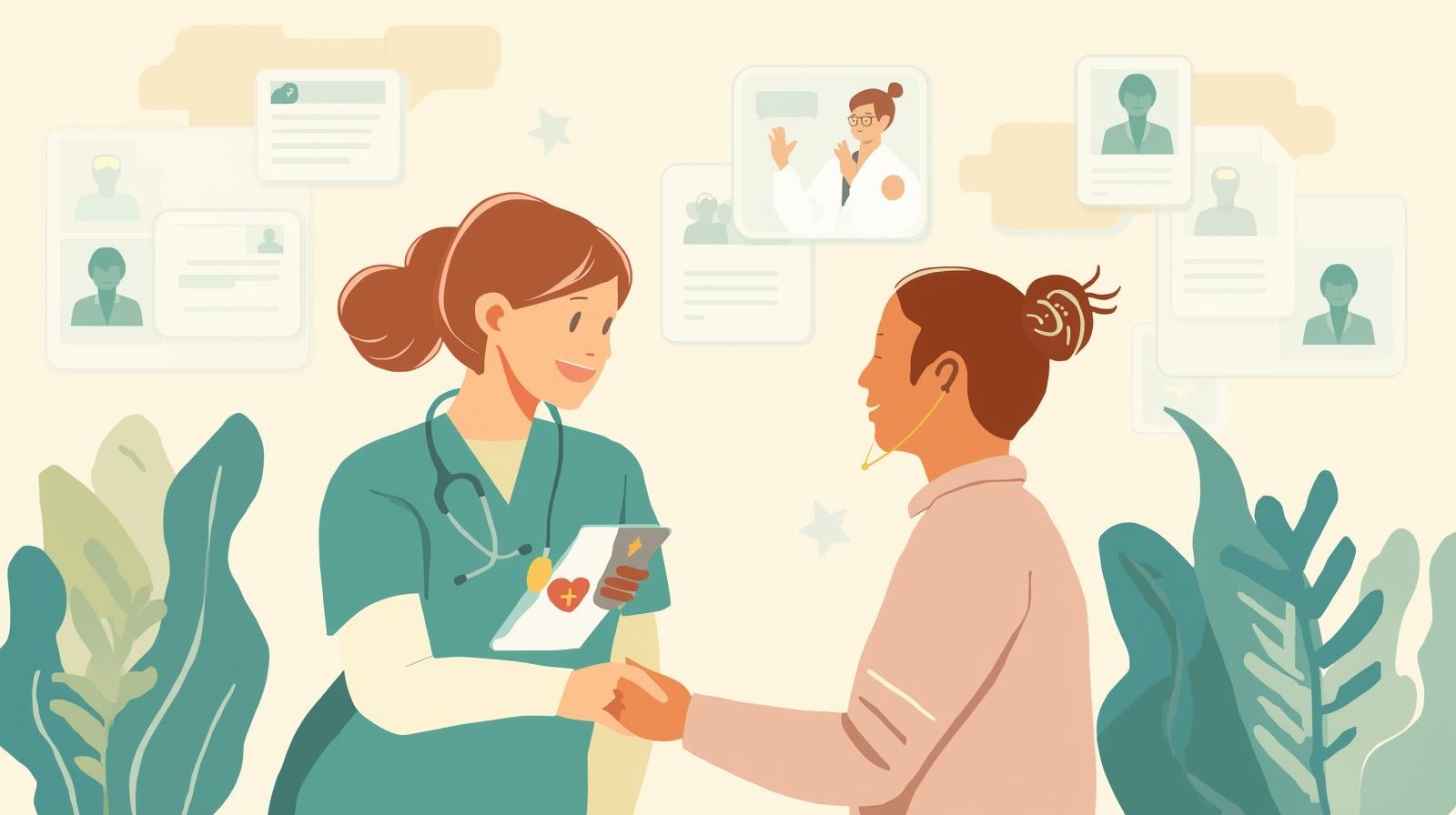
Picture a typical afternoon for a promotora at a small community health nonprofit. She visits an older man managing diabetes who needs help reading a new medication schedule, then drives across town to a family that missed a prenatal appointment because the bus route changed, then stops at a food distribution site to enroll three households in a nutrition program. At each stop she listens, explains, connects, and writes things down. By the time she gets home, she still has visit notes to finish, two referrals to follow up on, a screening form to upload, and a monthly report due Friday. The listening is why she took the job. The paperwork is why many people in her role eventually leave it.
The field is growing quickly. The US Bureau of Labor Statistics projects employment of community health workers to grow 13 percent from 2025 to 2035, much faster than average. Funding is shifting too. Roughly two dozen states now pay for CHW services through Medicaid in some form, and Medicare added community health integration codes in 2024. That money is welcome, but it arrives with documentation requirements that were designed for clinics, not for someone taking notes on a phone in a client's living room.
AI tools can help with a surprising amount of that operational work. Speech-to-text and summarization can turn a voice memo into a structured visit note. Translation and plain-language tools can produce first drafts of health education handouts in the languages your community speaks. Scheduling and mapping tools can make route planning less of a nightly puzzle. Summarization can pull a month of visit logs into a draft grant report. None of this is exotic anymore, and much of it runs on the same phones CHWs already carry.
This article is written for program directors, CHW supervisors, and operations staff at nonprofits that employ or contract community health workers. It is deliberately field-side. If you work inside a clinic, our companion piece on AI for community health centers covers intake, scheduling, and clinical documentation from that side. Here we stay with the outreach worker, and we keep AI firmly on the operational side of the work. Nothing in this guide recommends AI for clinical diagnosis, risk scoring, or deciding what a client needs. Those decisions belong to people, and the trust that makes CHWs effective belongs to them alone.
Why Field Outreach Is a Different Technology Problem
The American Public Health Association describes a community health worker as a frontline public health worker who is a trusted member of, or has an unusually close understanding of, the community served. That trust is what lets a CHW act as a bridge between residents and health and social services. It is also what makes the role so hard to support with technology designed for other settings. A tool that works beautifully at a front desk can feel intrusive, slow, or even alienating when it comes out during a home visit.
Field conditions create constraints that clinic software rarely anticipates. Connectivity is unreliable in rural areas, in apartment buildings with thick walls, and in neighborhoods where carriers have invested less. Many CHWs use personal phones, sometimes older models with limited storage. Visits happen in many languages, sometimes several in a single household. Time is fragmented: a CHW may have five minutes in the car between visits and nothing more until evening. And the people being served often have good reasons to be wary of anything that looks like surveillance, whether that wariness comes from immigration concerns, past experiences with institutions, or simply a desire for privacy.
The national CHW Core Consensus (C3) Project, which defined the roles and skills of the US workforce between 2014 and 2018, lists roles such as cultural mediation, culturally appropriate health education, care coordination, advocacy, outreach, and participation in evaluation. You can read its framework through the C3 Council. Notice how many of those roles are relational. AI can help with the documentation and logistics that surround them, but it cannot perform cultural mediation or advocacy. A useful test for any tool you consider is simple: does it give the CHW more time and attention for the person in front of them, or does it pull that attention toward a screen?
Where AI can help in the field
Operational work that surrounds the visit
- Turning voice memos into structured visit notes after the visit ends
- Drafting translated and plain-language education materials for human review
- Suggesting visit routes and flagging overdue follow-ups
- Checking that billing and grant documentation is complete
- Generating practice scenarios and quick reference answers for training
Field constraints to design around
If a tool ignores these, CHWs will stop using it
- Weak or no signal for much of the day
- Personal phones with mixed operating systems and limited storage
- Multiple languages and literacy levels in a single caseload
- Short, fragmented windows of time between visits
- Clients who are understandably cautious about being recorded or tracked
Documentation Where the Signal Drops: Offline Apps and Voice-to-Note Logging
The single biggest quality-of-life improvement for most CHW teams is not an AI feature at all. It is a documentation app that works offline. If a CHW has to wait for a signal to save a note, she will scribble on paper and type it up later, which doubles the work and invites errors. Before you evaluate any AI capability, confirm that your case management or data collection tool lets staff complete forms with no connection, stores the data encrypted on the device, and syncs automatically when a connection returns. Many mobile data collection platforms used in public health were built for exactly this situation. Our guide to offline-first AI tools for rural nonprofits walks through what to look for in sync behavior and conflict handling.
Voice-to-note logging is where AI adds real value on top of that foundation. The pattern that works best in the field is a short debrief recorded after the visit, not a recording of the visit itself. A CHW sits in her car for two minutes and says, in her own words and in whatever language is natural to her, what happened: who she saw, what they talked about, what resources she shared, what the client asked for, and what she promised to do next. A speech-to-text tool transcribes it, and a summarization step reorganizes the transcript into your note template, with fields for contact type, duration, topics, referrals made, and next steps. The CHW reviews the draft, corrects anything wrong, and saves it. Our article on voice-to-text documentation covers the mechanics of choosing and configuring transcription tools.
Recording a debrief rather than the visit matters for three reasons. First, it protects the relationship. Many clients will speak less openly if they see a phone recording, and asking for permission to record every conversation changes the feel of a home visit. Second, it limits the sensitive information you collect. A debrief captures what the program needs to know, not every detail a client shared in confidence. Third, it keeps the CHW as the author of the record. The note reflects her professional judgment about what mattered, which is exactly what a supervisor or auditor wants to see.
Offline transcription has improved a great deal. Some phones and apps can now transcribe speech on the device without sending audio to the cloud, which helps both in dead zones and for privacy. Accuracy varies by language, accent, and background noise, so test with your actual staff in your actual languages before committing. Spanish transcription is generally strong in mainstream tools, while languages such as Haitian Creole, Hmong, or Indigenous languages of Mexico and Central America may be poorly supported or not supported at all. Where on-device processing is not good enough, the safer pattern is to record locally and transcribe when the phone syncs over a secure connection to an approved service.
Build in review, every time. Summarization models sometimes add details that were never said, merge two clients' stories, or soften a concern into something routine. The CHW must read and confirm each note before it is saved, and your template should make that confirmation an explicit step. Over time, supervisors can spot-check AI-drafted notes against the original audio to find recurring errors, such as a tendency to misstate medication names or to drop the "next steps" section when a debrief runs long.
A field-ready voice debrief workflow
Fast for the CHW, structured for the program
- After the visit, not during: a one to three minute debrief recorded once the CHW has left the home
- A spoken checklist: who, contact type, time spent, topics, resources shared, referrals, client requests, and next steps
- Client identifiers kept minimal: use a case number or first name rather than full names and addresses in the audio
- Draft into your template: AI fills fields, and anything it cannot place goes into a "needs review" box rather than being guessed
- CHW confirms before saving: the note is not part of the record until the author has reviewed it
- Audio deleted on a schedule: once the note is confirmed, remove the recording unless policy requires keeping it
Multilingual Materials and Plain-Language Health Education
CHWs spend a great deal of time explaining written materials that were never designed for the people receiving them: discharge instructions full of medical terms, benefit notices in dense bureaucratic English, program flyers translated word by word into Spanish that no one actually speaks. AI is genuinely useful here, as long as it is used to produce first drafts that knowledgeable people then review. A program coordinator can take an approved English handout about managing blood pressure, ask an AI assistant to rewrite it at a sixth-grade reading level, and then ask for a Spanish version that uses everyday vocabulary from the community, rather than formal textbook Spanish.
The key is that AI should adapt approved content, not create health content from scratch. Start from materials your clinical partners, health department, or a reputable public health source have already vetted. Give the model that source text, tell it to preserve every factual statement, and ask it to simplify sentence structure, define unavoidable terms, and suggest where an illustration would help. Then have the draft reviewed twice: once by a bilingual staff member or CHW who speaks the community's variety of the language, and once by a clinical partner who confirms that nothing medically important was lost or changed. Our guide to reviewing AI translation quality describes a practical review process, and our piece on plain-language forms with AI covers readability techniques that carry over directly to health education.
CHWs themselves are often the best reviewers, because they hear every day which words confuse people and which explanations land. Some programs build a short feedback loop: when a CHW notices that clients consistently misunderstand a phrase in a handout, she records a quick voice note, and the coordinator uses it to revise the master version. Over time, AI can help maintain a glossary of preferred terms in each language, so that "blood sugar," "insurance card," or "referral" are translated consistently across every flyer and text message the program sends.
Be careful with real-time AI interpretation during visits. Live translation apps can help with simple logistics, such as confirming an appointment time with a family whose language no one on the team speaks. They are not a substitute for a qualified interpreter when health information, consent, or anything consequential is being discussed. Errors in live machine interpretation are hard to catch, and the client has no way of knowing what was lost. Where your organization or its clinical partners receive federal funding, civil rights rules on language access may also apply, so check with your partners about what interpretation standards they expect.
A prompt pattern for adapting approved materials
Adapt, do not invent
"Here is an approved handout from our clinical partner. Rewrite it for adults who read at about a sixth-grade level. Keep every factual statement and every number exactly as written. Do not add any new health advice. Use short sentences, define any medical term you must keep, and mark places where a picture would help. Then list any sentences you were unsure how to simplify without changing their meaning."
- Translate only after the plain-language English version is approved
- Name the specific community and variety of the language you are writing for
- Route every draft through a fluent community reviewer and a clinical reviewer
- Keep a dated master copy so you know which version CHWs are handing out
Planning Routes and Balancing Caseloads
Route planning sounds mundane until you watch a CHW spend half an hour each evening figuring out the next day's visits. She has to account for which clients prefer mornings, who works a night shift, which apartment complex has a gate code, where she can park, and which families are due for a follow-up this week. Mapping and scheduling tools with route optimization can take a list of addresses and time windows and propose an efficient order in seconds. That alone can return meaningful time to a team that drives across a large county.
AI-assisted planning becomes more useful when it connects to your case data. A supervisor can ask a reporting tool which clients have not had contact in thirty days, which referrals are past their expected follow-up date, and which CHWs are carrying more active cases than the program's target. Some case management platforms now surface these patterns automatically. The goal is not to have software assign visits, but to give supervisors a clearer view of where attention is needed so they can make better decisions in their weekly huddles.
Caseload balance deserves particular care. Raw case counts are a poor measure of workload in CHW programs, because one family navigating housing loss, a new diagnosis, and a benefits appeal may need more time than ten families who need a single appointment reminder. Rather than relying on an automated "acuity score," which edges toward the kind of risk assessment that should stay with people, ask CHWs to tag cases with simple, transparent workload categories, such as "light touch," "active navigation," and "intensive support." AI can then summarize workload by CHW and by neighborhood without making any judgment about the clients themselves.
Location data needs its own policy. Tracking where staff are in real time can raise safety benefits and also feel like surveillance, both to CHWs and to clients who notice. Many programs choose a middle path: CHWs check in and out of visits through the app, and location is recorded only at those moments, if at all. Whatever you choose, explain it clearly to staff, and never let route data become a de facto map of where vulnerable clients live that could be exposed in a breach.
Planning tools that respect the work
Support supervisor judgment, do not replace it
- Route optimization that honors client time preferences and CHW availability
- Weekly summaries of overdue contacts and open referrals for supervisor huddles
- Workload categories set by CHWs, not automated risk scores
- A written location data policy that staff understand and agree to
Closing the Loop: Referrals, Social Needs Screening, and Follow-Up Reminders
Referral follow-through is where CHW programs prove their value, and where they most often lose track. A CHW connects a client to a food bank, a utility assistance program, and a primary care appointment. Two weeks later, did the client actually get food, was the shutoff avoided, did she make it to the appointment? Answering those questions is the difference between "we made 400 referrals" and "we helped 400 people get what they needed." It is also tedious, because the information lives in phone calls, text messages, and partner portals that do not talk to each other.
AI can help in several practical ways. When a CHW logs a referral in a voice debrief, the summarization step can create a structured referral record with the partner organization, the date, and the expected follow-up window. The system can then generate a reminder for the CHW at the right time, with a short draft text message in the client's preferred language that she can personalize and send. For partners that send updates by email, AI can extract the relevant status from the message and suggest an update to the referral record for a staff member to approve. Our article on AI agents in case management explores how these follow-up workflows can be automated while keeping humans in control of every client-facing action.
Social needs screening is a close cousin of referral tracking, and AI's role there should be logistical. Many programs use standardized tools such as NACHC's PRAPARE or the Accountable Health Communities screening tool developed by CMS. AI can help with the paperwork around those screenings: making sure the right version and language of the form is loaded on each device, flagging forms that were started but not finished, converting paper forms photographed in the field into data entry drafts, mapping answers to the ICD-10 Z codes your clinical partners use for social needs, and producing aggregate counts of needs by neighborhood for program planning. Those are real time savings.
What AI should not do is interpret individual screening answers, decide which needs are most urgent, or determine what a client should be referred to. Those judgments depend on the conversation, on context the form never captures, and on the client's own priorities. A client who answers "yes" to housing instability may want help with rent, or may want nothing more than information for now. The CHW asks, listens, and decides with the client. Any screening answer that raises a safety concern should follow your program's established protocol and go straight to a human supervisor, with no automated step in between.
Referral and reminder support
Keep promises to clients from slipping
- Structured referral records created from voice debriefs
- Follow-up reminders timed to each referral type
- Draft check-in messages in the client's language for the CHW to edit
- Suggested status updates from partner emails, approved by staff
Screening logistics, not screening judgment
Let AI handle the forms, not the decisions
- Right form, right version, right language on every device
- Flags for incomplete screenings and missing consent
- Z code mapping drafts for clinical partners to verify
- Aggregate, de-identified need counts for program planning
The Reimbursement Paper Trail: Medicaid, Medicare, and Grant Reports
For years, most CHW programs ran entirely on grants. That is changing. According to a Center for Health Care Strategies 50-state scan, as of January 2024, 24 states reimbursed for CHW services through Medicaid, with three more states developing policies. Coverage looks different in each state: some pay through the state plan, some through managed care contracts, and covered services, eligible populations, and supervision rules vary widely. Programs often bill through a clinical partner rather than directly, since many states require services to be ordered or supervised by a licensed practitioner.
Several states use the CPT education and training codes 98960, 98961, and 98962 for CHW services, covering self-management education for one patient, two to four patients, and five to eight patients respectively, each in 30-minute units. The details are state specific. Some states tie these codes to face-to-face education using a standardized curriculum and cap the number of units per client, and California's Medi-Cal CHW billing FAQ addresses diagnosis code requirements and documentation that supervising providers must keep for audits. Always work from your own state's current Medicaid provider manual and your managed care contracts, because rules change frequently.
Medicare took a parallel step in its 2024 Physician Fee Schedule with community health integration (CHI) services, billed as HCPCS code G0019 for the first 60 minutes in a calendar month and G0022 for each additional 30 minutes. As the American Academy of Family Physicians explains, CHI services follow an initiating visit in which a billing practitioner identifies unmet social needs that interfere with diagnosis or treatment. The services are performed by certified or trained auxiliary personnel, including CHWs, under general supervision, and they can be provided by staff contracted through community-based organizations. The patient's consent must be documented, along with the social needs being addressed, the time spent, and how the activities relate to the treatment plan.
Notice how much of this depends on documentation that field staff produce: time spent, activities performed, the connection to a care plan, consent, and the number of people in a group education session. This is a natural place for AI to help, as long as it helps the CHW record what actually happened rather than inventing billable activity. A well-designed workflow can check each visit note against your billing requirements before it is submitted, flagging a missing duration, an absent consent record, or a group session without an attendance count. It can also total a client's CHI minutes for the month so a supervisor can see whether the G0019 threshold was reached. The final decision about what to bill stays with the billing practitioner and your compliance staff.
Grant reporting draws on the same records. Once visit notes, referrals, and screenings are structured, AI can draft the narrative sections of a quarterly report, summarize common barriers clients faced, and pull illustrative, de-identified examples from CHW notes for a funder update. Our guides to AI-assisted grant reporting and turning case notes into outcomes data go deeper on building those pipelines. The principle is the same as billing: every number in a report should trace back to a record, and every example should be checked by someone who knows the client and can confirm nothing identifiable slipped through.
Documentation checks AI can run
Before a supervisor or biller sees the record
- Is a start time, end time, or duration recorded for each contact?
- Is consent documented where the payer requires it?
- Does a group education note include the number of participants and the curriculum used?
- Does the note connect the activity to the client's care plan or identified social need?
- How many CHI minutes has each Medicare client accumulated this month?
Billing lines AI must not cross
Compliance risk is real and personal
- Never let AI fill in time, activities, or attendance that the CHW did not record
- Never let it "improve" a note to meet a billing threshold
- Do not let it choose codes without review by the billing practitioner
- Do not rely on any summary, including this one, over your state's current manual
Training and Supervision Support
Many CHWs are hired for who they are and whom they know, then trained on the job. State certification requirements, payer documentation rules, and program protocols all have to be learned quickly, often from a supervisor who is also carrying a caseload. AI can make that learning more accessible without replacing the mentoring that matters most. A program can load its own protocols, resource directory, and documentation guides into an internal assistant so a new CHW can ask, in her own words and her own language, "What do I do if a client wants help with a utility shutoff notice?" and get an answer drawn from the program's actual procedures, with a link to the source document.
Practice scenarios are another strong use. Supervisors can ask an AI assistant to generate realistic role-play scripts for common situations: explaining a new benefit, helping a client prepare questions for a doctor's appointment, or responding when a client is frustrated by a referral that went nowhere. New CHWs practice with a colleague, and the supervisor gives feedback. The AI drafts the scenario. The learning happens between people. Keep these scenarios focused on navigation, communication, and documentation skills, and leave anything involving clinical judgment or crisis situations to formal, clinician-led training.
For supervisors, AI-drafted summaries can make reflective supervision more productive. Instead of reading every note from the week, a supervisor can review a summary of each CHW's open referrals, incomplete documentation, and recurring barriers, then spend the supervision hour on the conversations that need it. Be clear with staff that these summaries support coaching, not performance surveillance. CHW burnout is a serious concern in the field, and a tool that feels like a monitoring system can erode morale quickly. Our article on training staff with no prior AI knowledge offers approaches that work for teams with varied comfort levels, which describes many CHW workforces well.
Training uses that build confidence
AI drafts, people teach
- An internal assistant grounded only in your protocols and resource directory, with sources cited
- Role-play scenarios for navigation and communication skills, practiced with peers
- Quick-reference cards on documentation requirements in each staff language
- Weekly supervision summaries framed as coaching support, never as surveillance
Privacy on Personal Phones: HIPAA, Consent, and Device Security
Whether HIPAA applies to your CHW program depends on how it is structured. If your nonprofit is a covered entity, such as a clinic that bills electronically, or if your CHWs work on behalf of one under a business associate agreement, the protected health information they handle falls under HIPAA. Many CHW programs contract with health systems, health plans, or clinics in exactly this way, which means HIPAA follows the data into the field. Programs funded only by grants and not working on behalf of a covered entity may not be subject to HIPAA, but state privacy laws, funder requirements, and plain ethics still call for strong protections. Our guide to HIPAA and AI data protection explains how to tell which situation you are in.
AI tools add a specific risk: data sent to a vendor for transcription, summarization, or translation. If HIPAA applies, any vendor that processes protected health information on your behalf needs a signed business associate agreement, and consumer versions of AI chatbots and transcription apps generally do not offer one. Even where HIPAA does not apply, read the vendor's terms on data retention and model training. A CHW pasting a client's story into a free AI app to "clean up the note" may be sharing that story with a company that keeps it indefinitely. Give staff approved tools so they are never tempted to improvise.
Personal phones are the reality for many programs, and HHS has long acknowledged that providers use mobile devices with health information as long as appropriate safeguards are in place. The HealthIT.gov guidance on managing mobile devices recommends deciding how devices will be used, assessing the risks, and adopting safeguards and policies before allowing access to health information. In practice, that means a screen lock, device encryption, automatic updates, the ability to remotely wipe work data, and keeping client information inside an approved app rather than in the phone's camera roll, text messages, or personal email. Mobile device management tools can separate work data from personal data so that a lost phone does not become a breach, and so that the organization can remove its data without touching a CHW's family photos.
Consent deserves its own thought in a CHW context. Clients should understand, in plain language and in their own language, what information the program records, who sees it, whether any AI tools process it, and how long it is kept. That explanation is itself an act of trust. Many programs find that a short, honest script delivered by the CHW works better than a dense form: "I write a short note after each visit so I remember what we talked about and what I promised to do. Only our team sees it. I never record our conversations." If your program does use AI to process notes, say so. Our article on on-device AI for nonprofits covers options that keep more data on the phone itself, which can simplify both the privacy picture and the explanation.
Minimum device standards
For any phone that touches client data
- Screen lock with a strong passcode or biometric, and automatic locking
- Device encryption and current operating system updates
- Work data contained in approved apps that can be wiped remotely
- No client photos, names, or details in personal texts, galleries, or email
- A clear, fast process for reporting a lost or stolen phone
AI vendor questions to ask
Before any client data reaches a tool
- Will you sign a business associate agreement if HIPAA applies?
- Is our data used to train your models, and can we turn that off?
- How long are audio files and transcripts retained, and where?
- Does it work offline or on-device for the languages our CHWs use?
Protecting the Relationship That Makes CHWs Work
The research base for CHW programs rests on one idea: people trust someone who shares their language, their neighborhood, and often their life experience, and that trust opens doors that institutions cannot. Every technology decision in a CHW program should be measured against that idea. AI that saves a CHW an hour of evening paperwork gives her an extra hour of patience and presence the next day. AI that puts a screen between her and her client, or that makes clients feel watched, spends down the very asset the program exists to build.
There are a few clear lines worth writing into policy. Clients should never be handed off to a chatbot in place of their CHW. AI should never contact a client directly without a CHW reviewing and approving the message. AI should not be used for clinical diagnosis, for scoring a client's risk, or for deciding which clients get attention first. Those uses shift judgment from someone who knows the client to a system that does not, and they carry real potential for bias against the communities CHW programs serve. If a vendor pitches an "engagement score" or "risk prediction" for your caseload, ask hard questions about how it works and who it might disadvantage, and remember that you can simply decline.
Involve CHWs in every decision. They know which tools will feel natural in a home visit and which will feel cold. They know which clients will be fine with a voice debrief and which will want reassurance. Programs that pilot tools with a small group of CHWs, gather their honest feedback, and adjust before rolling out widely tend to see far better adoption than programs that announce a new system from the top. And ask clients too. A short question during a follow-up, such as "Has anything about how we keep notes made you uncomfortable?", can surface problems long before they become breaches of trust.
A simple test for every tool. After a month of use, ask your CHWs two questions: Do you have more time with clients than before? Do clients seem as comfortable with you as they did before? If either answer is no, the tool is not working, regardless of what the dashboards say.
Keep AI on the operational side of the work. Diagnosis, risk assessment, and decisions about what a client needs belong to people with the training and relationships to make them.
A Practical Rollout for a Small CHW Program
Most CHW programs do not need a large technology project to benefit from AI. A phased approach keeps risk low and lets you learn as you go. Start with the foundation: an offline-capable documentation app, approved and secured on every device, with a clear privacy policy that staff can explain to clients. Without that, AI features will only add complexity.
Next, pick one pain point that CHWs themselves name most often. For many teams, it is end-of-day note writing, so a voice debrief pilot with three or four volunteers is a natural first step. Run it for a month, compare time spent on documentation before and after, review a sample of AI-drafted notes for accuracy, and ask the pilot group what they would change. If the pilot works, expand it, then move to the next pain point, such as referral reminders or plain-language materials.
Bring billing and reporting in once your notes are consistently structured. Work with your clinical partners and billing staff to translate your state's Medicaid requirements and, if relevant, Medicare CHI requirements into a documentation checklist, then let AI check notes against that checklist. Finally, use the structured data you are now collecting to draft grant reports and program summaries, always with human review. Each step builds on the last, and each one should leave CHWs with more time for the people they serve.
Rollout sequence at a glance
Foundation first, then one pain point at a time
- Foundation: offline documentation app, device security standards, privacy policy, and client consent script
- Pilot: voice debriefs with a small group of volunteer CHWs, measured and reviewed
- Expand: referral reminders, plain-language and translated materials, route planning
- Reimbursement: documentation checks aligned with your state Medicaid manual and Medicare CHI rules
- Reporting: AI-drafted grant reports and program summaries, verified against records
- Ongoing: monthly check-ins with CHWs on time saved and client comfort
Test in the real field. Before you commit to any tool, have CHWs try it in the places they actually work: the rural road with one bar of signal, the apartment basement, the noisy community event. A demo in your office Wi-Fi tells you very little about how it will perform on a Tuesday afternoon visit.
Conclusion
Community health workers carry two loads at once: the relational work of earning and keeping their neighbors' trust, and the administrative work that funders, payers, and partners require. As Medicaid and Medicare open new reimbursement paths, the administrative load is growing just as the workforce is expanding. AI can lighten that load in practical, unglamorous ways: offline voice debriefs that become structured notes, first drafts of plain-language and translated materials, smarter route planning, referral reminders that keep promises from slipping, and documentation checks that make billing and grant reporting less painful.
The guardrails matter as much as the tools. Keep CHWs as the authors of every record and the senders of every message. Use AI to adapt vetted health content, never to create clinical advice. Protect client data on personal phones with real device security, signed agreements where HIPAA applies, and honest consent conversations. And keep AI out of diagnosis, risk scoring, and decisions about what clients need.
Measured against the right standard, success is easy to recognize. CHWs spend less time on their phones at night and more time present with the people they serve. Clients feel as comfortable as they ever did. Supervisors see clearer data, and funders get more accurate reports. That is what supporting community health workers with AI should look like.
Give Your Outreach Team More Time in the Field
We help CHW and promotora programs design field-ready documentation workflows, choose privacy-conscious AI tools, and align their records with Medicaid, Medicare, and funder requirements, without losing the relationships that make the work effective.