
Beyond One-Time Training: Building Continuous AI Learning Pathways for Nonprofits
AI tools and the rules around them are changing faster than the training calendars that were built to keep up with them. A workshop in February cannot stay current through November on its own. This is a practical guide to building the connected, sustained learning pathways that turn AI literacy from a one-time event into a durable organizational capability.
Most nonprofits have, by now, run at least one all-staff training on AI. It usually goes well in the moment. People show up curious, ask good questions, leave with a few new prompts, and feel a little less anxious about what AI means for their work. Then the calendar advances. New models ship. The interface they were taught on gets redesigned. A new internal use case comes along that nobody covered. Within six months, the gap between what the training delivered and what the team actually needs has widened uncomfortably.
This is not a critique of the people who designed the training. It is the predictable result of treating AI as a topic that can be addressed in a single event. Other technologies, like project management software or video conferencing, were close enough to static that a one-time training could carry staff for a year or more. AI is different. The underlying models change every few months. The recommended ways of using them change with them. The regulatory environment moves alongside, with new disclosure rules, new compliance frameworks, and new vendor obligations appearing regularly. None of this gets captured in a slide deck from last spring.
The U.S. Department of Labor's AI Literacy Framework, released in early 2026, names this directly. One of the framework's seven delivery principles is to "create pathways for continued learning," explicitly recognizing that AI literacy is not a one-time event but a sustained capability that grows alongside the technology. The framework is voluntary, but its central insight applies to any nonprofit trying to keep staff effective with AI: the right unit of analysis is the learning pathway, not the training session.
This article is for nonprofit operations leaders, executive directors, and HR or learning and development staff who have already run their first AI training and are wondering what comes next. It is also for organizations that have not yet started, and want to build a learning approach from day one that will hold up over time. The work is genuinely doable at small budgets, but it requires thinking about AI learning as an ongoing program, not a calendar event.
Why One-Time AI Training Stops Working
A single training cannot serve as a sustained learning experience for three structural reasons, and they all compound. Together they explain why nonprofits that invested in a strong launch event still find themselves, a year later, with a team that is unevenly skilled and quietly nervous about whether they are using AI tools correctly.
The first reason is the pace of change. Major AI model releases now happen roughly every quarter, and each release tends to change what is possible, what is recommended, and what is safest. Workflows that were the right answer in January may be inefficient or even risky by July. A staff member trained once is steadily losing accuracy without ever knowing it.
The second reason is role-specific divergence. The skills that make a development associate effective with AI are not the same as the skills that make a case manager effective with AI. A one-time, all-staff training has to flatten these differences to be deliverable in a single session. That is fine as an entry point. It does not work as a sustainable approach, because the actual workflows different roles need to master diverge quickly once people start using AI for real work.
The third reason is reinforcement. Adult learners retain very little of what they hear in a single session unless they apply it within a short window and have somewhere to ask follow-up questions. Without a follow-up structure, the most useful insights from a training session evaporate within weeks. The training looked great in the room. It does not hold up in the day-to-day, because there is no scaffolding around it.
Signs Your Nonprofit Has Outgrown One-Time Training
Indicators that a one-and-done training approach is no longer serving your staff.
- Staff report knowing AI tools exist but feeling uncertain about whether they are using them correctly.
- The skill gap between early adopters and the rest of the team is widening rather than closing.
- Questions about AI use cluster around a few informal experts who are quietly absorbing significant unpaid coaching time.
- New hires arrive with no structured way to come up to speed on the organization's AI tools and norms.
- You can name the date of your last AI training but cannot describe what staff have learned since then.
What an AI Learning Pathway Actually Looks Like
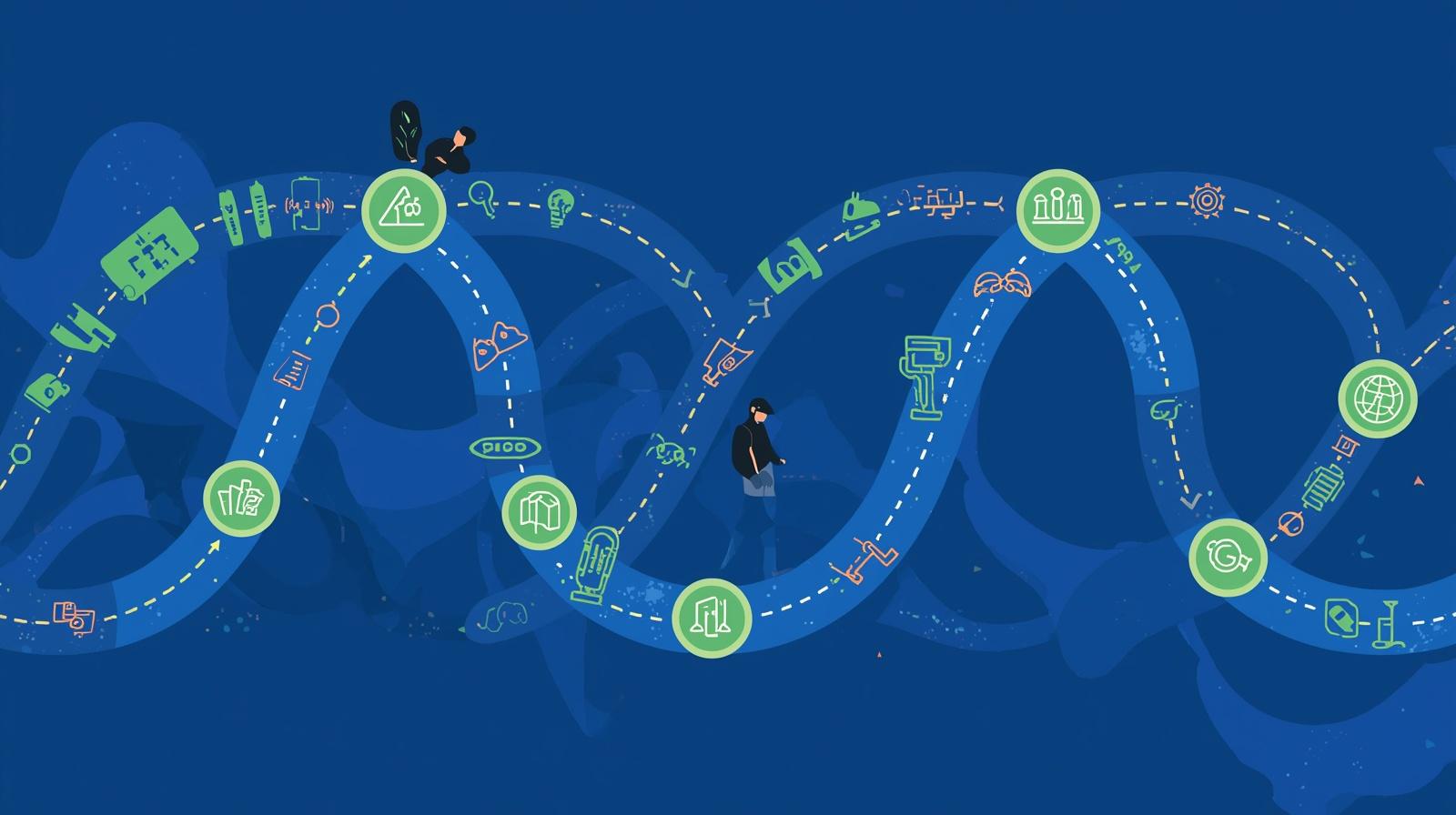
A learning pathway is not a longer training. It is a connected sequence of learning experiences, support resources, and feedback loops that move a staff member from where they are to where they need to be, with explicit recognition that "where they need to be" will keep changing. The DOL framework calls this stackable learning: structured layers that build from foundational literacy to deeper skills in areas like prompt engineering, data handling, or AI tool configuration, with alignment to the specific tasks and tools associated with each job role.
For a nonprofit, this can be more modest than it sounds. The pathway does not need to be a polished corporate learning platform. It needs to do three things. It needs to give every staff member a clear starting point appropriate to their role and confidence level. It needs to provide ongoing learning experiences that build on the starting point, including refreshers when tools change. And it needs to offer accessible places to ask questions, practice with peers, and get feedback on real work.
The components that make this happen are largely internal. A starting pathway is usually a short series of foundational sessions tied to the five foundational areas in the DOL framework: understanding how AI works, exploring AI uses, prompting AI effectively, evaluating AI outputs, and managing AI responsibly. Beyond that foundation, role-specific tracks emerge: fundraising staff dive deeper into donor communications and grant writing workflows, program staff explore service delivery applications, and finance and operations teams focus on automation and analysis.
Around those tracks sit reinforcement mechanisms. A monthly office-hours session where staff can bring real prompts and get help. A shared prompt library that grows over time as effective patterns emerge. An internal Slack or Teams channel where questions get answered quickly. Occasional deep-dive sessions when something significant changes, like a new model launch or a new internal use case. None of these individually is heavy. Together, they form a pathway. Our piece on applying the DOL framework to nonprofit training goes deeper on how to structure these layers.
Five Building Blocks of a Sustainable AI Learning Pathway
Each of these building blocks is achievable for a small or midsize nonprofit. They do not require a dedicated learning and development team, though they benefit from one. They do require that someone owns the program and that leadership treats it as recurring work, not a project that ends.
1. A Clear Foundational Curriculum
Every staff member should complete a short foundational sequence within their first thirty to sixty days, mapped to the five DOL content areas. This is the common ground that everything else builds on.
2. Role-Specific Tracks
After the foundation, staff move into role-aligned modules: development, programs, communications, finance and operations. Each track focuses on the AI workflows most relevant to that work.
3. Peer Learning and Office Hours
A predictable monthly or biweekly venue where staff can bring real work, share what is working, and get help with what is not. This is where most actual learning happens.
4. A Shared Resource Library
A maintained library of prompts, templates, internal examples, and short reference guides. The library is asynchronous learning that supplements the live sessions and serves new hires.
5. Refresh and Update Cadence
A regular rhythm, usually quarterly, where someone reviews what has changed in tools, regulations, or internal use, and updates the curriculum, the resource library, and the staff communications accordingly. Without this rhythm, the pathway slowly becomes obsolete.
Embedding Learning in Real Work
The DOL framework places strong emphasis on experiential learning and on embedding learning in context. Both principles matter even more for resource-constrained nonprofits, because they convert learning from a separate expense into something that happens alongside the work people are already doing. Done well, this is the single biggest unlock for making continuous learning affordable.
Practically, embedding looks like this. Instead of a separate prompt engineering workshop, the next time a development associate is drafting a grant narrative, the AI champion sits with her for thirty minutes and works through how to use the tool effectively on that specific narrative. Instead of a general session on evaluating AI outputs, the next time a program manager reviews a chatbot transcript for quality, the operations director walks through the evaluation checklist with him in the moment. The learning is shorter, more specific, and more memorable, because it is anchored to a real task.
Embedding does not eliminate the need for structured learning. The foundational curriculum, the role-specific tracks, and the office hours all remain. What embedding does is multiply the impact of those structured events by ensuring that what staff learn shows up in their actual work, with the support to make it stick. Without embedding, the curriculum becomes a parallel track that staff dutifully complete but never integrate. With embedding, the curriculum becomes the launchpad for daily practice.
Embedding also depends on a small number of people inside the organization who are willing to play the role of in-context coach. These are the AI champions, formally or informally designated, who help colleagues at the moment of use. Resourcing them deliberately, including budgeting for their time, is one of the most leveraged moves a nonprofit can make in AI learning. The mechanics of building this group are covered in our piece on building AI champions.
Measuring Whether the Pathway Is Working
A learning pathway that no one measures will drift. Measurement does not need to be elaborate, but it does need to exist. The two simplest places to start are self-assessment and observable behavior. Self-assessment can be a short twice-yearly survey that asks staff to rate their confidence on the five DOL content areas relative to their role. Observable behavior can be a regular review of how AI is showing up in the work itself: prompt patterns appearing in the shared library, AI use surfacing in case notes or development reports, training questions clustering around particular topics that signal gaps.
A more structured option is an AI literacy assessment matrix that captures expected competencies for each role and lets managers and staff jointly evaluate where someone stands. This sits well alongside performance review cycles, where AI literacy can be one of several capabilities discussed. Our piece on AI literacy assessment matrices walks through a sample structure that nonprofits can adapt.
Whichever approach you choose, the goal is not to grade people. It is to give the program a feedback loop. The signals you gather should feed directly into the refresh-and-update cadence described above, so that the next quarter's curriculum, office hours, and resource library updates reflect what staff actually need next. Without that loop, the pathway becomes static, and the same problems that doom one-time training quietly reappear in a different form.
Resourcing a Pathway You Can Actually Sustain
The most common reason nonprofit AI learning programs collapse is not that they were poorly designed. It is that no one owned them after launch. A pathway requires an owner. That owner does not need to be a full-time learning and development professional. In most nonprofits, the role can be embedded in an operations director, a chief of staff, or a senior program manager who has a defined slice of time, typically two to five hours a week, to curate the curriculum, run office hours, maintain the resource library, and update the program quarterly.
Underwriting that time honestly is essential. Treat it the way you would treat any other ongoing operational responsibility. Put it in the role description, account for it in workload, and make it visible in performance conversations. The alternative is that the work happens informally, in evenings, until the person doing it burns out or moves on, and the program quietly dies.
The financial cost of the pathway itself is usually modest. The biggest line items are people's time and a handful of paid external resources, such as an annual subscription to a respected AI learning platform or occasional outside facilitators for deeper sessions. The hidden cost is the staff time spent on training itself, which should be planned into the calendar rather than absorbed silently. Even an hour a month per staff member, multiplied across a thirty-person organization, is real time, and the program should be designed to use that time well.
Funders are increasingly receptive to including AI capability building in operating support requests. If your nonprofit has a sympathetic foundation partner, a short conversation about funding the staff time and tooling needed to sustain an AI learning pathway is often well received, particularly when paired with a clear plan for the kind of pathway described here.
Conclusion
The shift from one-time AI training to continuous AI learning pathways is not a luxury. It is the consequence of choosing tools that themselves change continuously. A nonprofit that runs one strong training and then leaves its team to figure out the rest will steadily fall behind, not because anyone did anything wrong, but because the underlying technology will not hold still.
The encouraging news is that a pathway is genuinely buildable at small budgets. A foundational curriculum, role-specific tracks, peer learning, a shared library, and a refresh cadence form a structure that small nonprofits can stand up with a few hours a week of dedicated ownership. The DOL AI Literacy Framework, while voluntary, provides a credible scaffold to organize around. The framework's emphasis on stackable, experiential, embedded learning aligns closely with what works in nonprofit environments anyway.
If your nonprofit already runs an AI training program, the practical next step is to audit it against the five building blocks above and identify which is weakest. If you have not yet started, the practical next step is to design from the pathway level rather than from the session level. Either way, the goal is the same: an organization where AI literacy is something staff continuously build, not something they were once exposed to in a meeting last year.
Ready to Build Lasting AI Capability?
One Hundred Nights helps nonprofits design AI learning pathways that match their staff, their tools, and their mission. If you want to move beyond one-time training, we can help.