
Digital Commerce for Nonprofits: Unifying Fundraising, Merch, Events, and Email into One Ecosystem
Most nonprofits are running four or five disconnected revenue systems that don't know about each other. Unifying them into a single digital commerce ecosystem isn't just an operational improvement, it's a fundraising strategy with measurable returns.
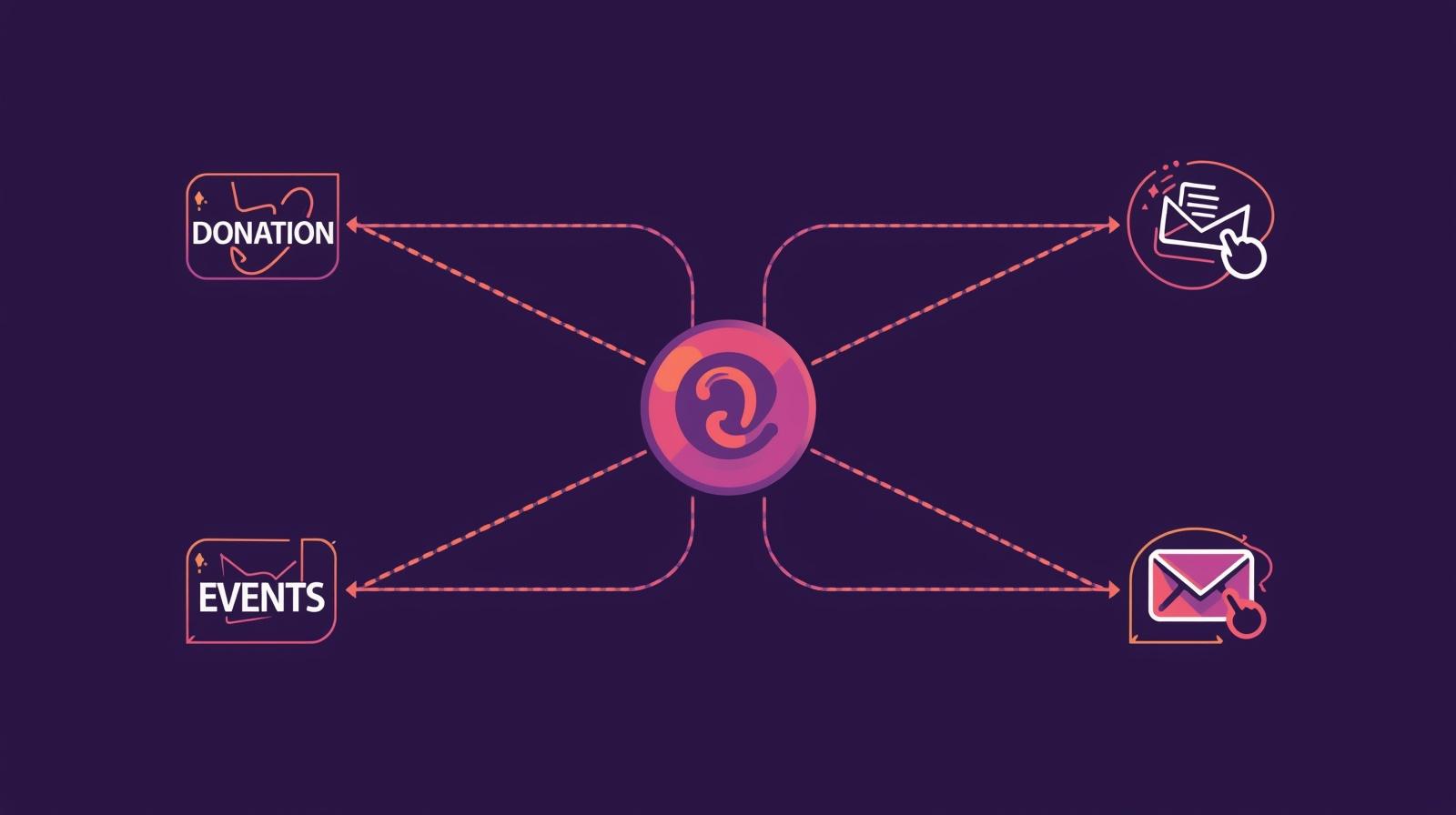
A donor attends your gala, buys a branded hoodie from your online store, and signs up for your monthly newsletter. In most nonprofits, these three interactions are recorded in three different systems, with no connection between them. The gala is in Eventbrite, the hoodie purchase is in Shopify, and the newsletter signup is in Mailchimp. Finance reconciles all three manually every month. That donor appears as three different people in three different platforms.
This fragmentation is so common in the nonprofit sector that most organizations have accepted it as the cost of doing business. But the cost is real, not just in staff time and reconciliation headaches, but in lost revenue. When your systems don't share data, you can't personalize outreach based on a supporter's complete history. You can't trigger a giving appeal to someone who just bought merchandise. You can't see that your most loyal event attendees are also your highest-value donors. You're flying blind on the relationships that matter most.
The nonprofit technology landscape in 2026 has finally matured to offer genuine unified commerce solutions across a range of budget levels. Whether your organization has a $200K budget or a $10M budget, there's a realistic path to treating fundraising, merchandise, events, and email as a single interconnected system rather than four separate problems. This article walks through what that looks like, why it matters, and how to get there.
The Fragmentation Tax Your Nonprofit Is Already Paying
The average U.S. nonprofit with a budget between $2 million and $10 million uses seven to twelve separate software tools to manage its revenue operations. This "frankenstack" typically includes a standalone donation processor, a separate email marketing platform, a third-party event registration system, a merchandise store, a CRM that may or may not receive data from any of these, and a spreadsheet or accounting software that tries to pull it all together. Every seam between systems is a failure point.
The most immediate cost is staff time. Finance and development teams at nonprofits with fragmented stacks spend significant hours each month exporting data from one system, cleaning it, importing it into another, and reconciling discrepancies when records don't match. Payment data arrives from Stripe in one format, from PayPal in another, and from Eventbrite in a third. The person responsible for the CRM is constantly playing catch-up, manually updating donor records from sources that don't automatically sync.
The subtler cost is invisible revenue. When a merchandise buyer isn't recognized as a potential donor, that relationship never gets cultivated. When an event attendee isn't automatically added to a post-event email sequence, you lose the momentum of their engagement. When you can't see a supporter's lifetime value across all revenue channels combined, you have no way to prioritize who deserves personal outreach from your development director. Fragmentation doesn't just create administrative burden, it actively suppresses fundraising potential.
Data integrity is another dimension of the problem. Every time constituent data crosses a system boundary, it's at risk of corruption. An email address is typed differently in two systems. A last name changes after marriage. A donor record gets duplicated across platforms. When you finally try to calculate a supporter's true lifetime engagement, you're starting from unreliable data. The technical debt of fragmentation compounds over time.
Data Integrity Risk
Duplicate records, inconsistent data, and broken attribution across platforms make accurate reporting nearly impossible.
Lost Revenue
Without unified data, cross-channel opportunities go unrecognized. Merchandise buyers, event attendees, and donors remain strangers to each other in your systems.
Reporting Blindness
Boards and funders expect unified revenue dashboards. Fragmented systems require manual aggregation that is slow, error-prone, and expensive.
The Four Revenue Streams That Need to Speak the Same Language
Unified digital commerce for nonprofits isn't about doing something radically new. It's about connecting revenue channels that already exist in most organizations: direct fundraising (online donations, recurring giving, major gifts), merchandise (branded products, impact kits, print-on-demand), events (galas, workshops, conferences, virtual events), and communications (email marketing, automated sequences, newsletters). When these four channels share a single constituent database, they stop competing and start amplifying each other.
Direct Fundraising
Online donations, recurring giving, peer-to-peer campaigns
Online giving is typically the largest revenue channel for digitally mature nonprofits, and the one with the most mature technology ecosystem. Modern giving platforms go far beyond a simple donation form: they handle recurring giving management, intelligent ask amount optimization, peer-to-peer campaign infrastructure, and real-time analytics. The key is ensuring that this giving data flows automatically into your central constituent record, where it can inform how you communicate across all other channels.
- Recurring giving management with intelligent churn prediction
- AI-optimized ask amounts based on donor history and peer behavior
- Automatic donor record creation and CRM sync upon first gift
Merchandise and Products
Branded goods, impact kits, cause-related products
Merchandise programs represent between 4 and 7 percent of total revenue for nonprofits with active product offerings, but their value goes beyond direct revenue. A supporter who buys a t-shirt is signaling mission alignment that should trigger donor cultivation. A merchandise buyer who hasn't made a financial gift yet is a warm prospect who already has a financial relationship with your organization. Unified commerce means merchandise purchases flow into the same constituent profile as donations, enabling behavior-triggered outreach that a disconnected Shopify store could never support.
- Merchandise buyer automatically identified as potential donor prospect
- Purchase history informs personalized product recommendations
- Recurring "impact kit" subscriptions build habitual mission engagement
Events and Experiences
Galas, workshops, virtual events, membership programs
Events represent between 15 and 25 percent of total revenue for mid-size nonprofits, yet event registration systems are among the most frequently siloed tools in the nonprofit technology stack. When event registrations don't flow automatically into your CRM, you lose the opportunity to follow up intelligently with people who attended your gala but haven't made a donation. You also miss the ability to identify which of your donors are your most engaged event participants, which is critical information for major gift cultivation.
- Event attendance recorded in constituent profile alongside giving history
- Post-event email sequences triggered automatically for first-time attendees
- Multi-event engagement used to identify major gift prospects
Email and Communications
Newsletters, automated sequences, personalized appeals
Email is the connective tissue of a unified digital commerce ecosystem. When your email platform shares constituent data with your giving platform, event system, and merchandise store, you can send communications that reflect a supporter's actual relationship with your organization rather than generic broadcast messages. A donor who hasn't given in six months receives a lapsed donor sequence. A merchandise buyer who has never given receives a mission-focused cultivation sequence. An event attendee receives a post-event follow-up with a soft giving ask. None of this is possible without shared data.
- Behavior-triggered sequences based on giving, event, and purchase activity
- Suppression of donation appeals to current active donors
- Personalized subject lines and content based on engagement history
The Donor-as-Customer Insight Driving This Shift
The conceptual shift underlying unified nonprofit commerce is deceptively simple: your supporters are not donors who occasionally do other things. They are customers whose relationship with your organization spans multiple transaction types, and managing that relationship well requires a complete picture of all those transactions together. The for-profit world figured this out decades ago, which is why Amazon knows your full purchase history and can recommend products, trigger re-engagement, and identify at-risk customers based on behavior changes. Nonprofits are applying the same logic to mission-driven relationships.
The implications run deeper than operational convenience. Research from major giving platforms shows that donors who engage with an organization across three or more product types, meaning they give, attend events, and purchase merchandise, have dramatically higher lifetime value than donors who only give. When you treat fundraising, events, and merchandise as separate programs with separate audiences, you are leaving that compounding engagement value on the table. When you treat them as a single supporter journey, you create the conditions for supporters to deepen their relationship at each touchpoint.
This shift also changes how you think about acquisition. A merchandise buyer is not a failed donor, someone who didn't give money. They are a successfully acquired supporter at the beginning of a relationship that could evolve into giving. An event attendee who hasn't given yet is a cultivated prospect, not a non-donor. Unified commerce makes these relationship trajectories visible and actionable in ways that fragmented systems never can.
Platform Options by Organization Size
The nonprofit technology market now offers viable unified commerce options at every budget level. The right platform depends on your organization's budget, technical capacity, current system investments, and specific revenue mix. Here is a realistic breakdown by organizational scale.
Small Nonprofits (Under $500K Budget)
All-in-one platforms that minimize configuration and cost
For smaller organizations, the priority is eliminating administrative overhead rather than achieving sophisticated personalization. Platforms like Zeffy and Givebutter offer genuinely unified fundraising, event ticketing, merchandise, memberships, CRM, and email in a single interface with no per-transaction fees. They trade some depth and customization for dramatically lower administrative burden. Organizations that migrate to these platforms typically report saving five to ten hours of staff time per week on reconciliation and data management tasks. The trade-off is limited advanced automation and analytics compared to enterprise platforms, but for small teams, that is rarely the binding constraint.
- Zeffy: 100% free platform with donations, events, ticketing, memberships, and forms
- Givebutter: Fundraising, events, CRM, email, and merch with no per-transaction fees
- Primary benefit: elimination of multi-platform reconciliation and data silos
Mid-Size Nonprofits ($500K to $5M Budget)
Integrated stacks with deeper automation and analytics
Mid-size organizations typically have the budget and staff capacity to manage a more sophisticated stack, but not the resources for a full enterprise implementation. A common and effective approach is HubSpot for Nonprofits as the CRM and email hub, Stripe as the unified payment infrastructure across giving, events, and merchandise, and Classy or Fundraise Up for online giving with AI-optimized donation forms. This stack connects through native integrations and Zapier/Make automations, providing unified constituent data without the cost of a full enterprise deployment. Organizations running this stack gain personalized email automation, donor lifecycle tracking, and cross-channel revenue visibility while staying within budget.
- HubSpot for Nonprofits + Classy: Powerful CRM and email automation with best-in-class giving UX
- Bloomerang: Donor retention CRM with built-in email and Shopify integration for merch
- Integration layer via Zapier, Make, or native connectors keeps constituent data synchronized
Large Nonprofits ($5M+ Budget)
Enterprise suites with a genuine single source of truth
Larger organizations can access full enterprise unified commerce through the Salesforce ecosystem (NPSP for CRM, Marketing Cloud for email, Commerce Cloud for merchandise, and Experience Cloud for digital portals) or Blackbaud's NXT suite. These platforms offer true single-source-of-truth architecture where a supporter's every interaction is recorded in a single system, enabling sophisticated predictive analytics, major gift identification, and board-level reporting dashboards. Implementation costs are significant, ranging from tens to hundreds of thousands of dollars, but the ROI case for organizations doing $10M or more in annual revenue is typically compelling when modeled properly.
- Salesforce NPSP suite: Industry-leading enterprise unified commerce for large NGOs
- Genuine single constituent record across giving, events, merchandise, and communications
- AI-powered donor scoring, retention prediction, and major gift identification built in
AI Features That Only Work with Unified Data
This is perhaps the most compelling argument for unified commerce in 2026: the AI capabilities built into modern nonprofit platforms can only deliver their value when they have access to a complete picture of supporter behavior across all channels. An AI that can see only donation history can predict giving behavior. An AI that can see donation history plus event attendance plus merchandise purchases can predict something much more valuable: which supporters are on a trajectory to become major donors, which are at risk of lapsing, and which have untapped capacity that isn't yet showing up in their giving.
Smart ask amount optimization, now available in platforms like Fundraise Up and Classy, uses machine learning to personalize donation ask amounts in real time based on a donor's history and behavioral signals. When this AI has access not just to giving history but to event attendance frequency, merchandise purchase patterns, and email engagement rates, its predictions become dramatically more accurate. The AI isn't just asking "how much has this person given before?" but "what does this person's complete relationship with our organization tell us about what they're capable of giving?"
Predictive donor retention is another AI use case that depends on unified data. Bloomerang, Salesforce NPSP, and several other platforms now offer AI-powered donor health scores that flag at-risk supporters before they lapse. These models work best when they incorporate behavioral signals beyond giving: a longtime donor who stops opening emails, skips an event they've attended for three consecutive years, and declines a merchandise offer is showing a different risk profile than one who simply hasn't given yet this fiscal year. Without unified data, you can't build that complete picture.
Smart Ask Optimization
ML-powered personalized ask amounts based on complete supporter history across all channels. Platforms report significant increases in average gift size when cross-channel data informs these models.
Retention Prediction
AI donor health scores that incorporate email engagement, event attendance, and purchase behavior to identify at-risk supporters weeks before they lapse.
Major Gift Identification
Cross-channel engagement patterns are often more predictive of major gift capacity than giving history alone. Unified data makes this analysis possible without external wealth screening.
Personalized Email Content
Generative AI email personalization goes beyond inserting a first name. With unified data, AI can reference a supporter's actual history with your organization in each message.
Implementation Roadmap: Consolidating Without Breaking What Works
The most common mistake in nonprofit platform consolidation is trying to do too much at once. Organizations that attempt to migrate all four revenue channels simultaneously almost always encounter cost overruns, staff burnout, and data quality problems that undermine confidence in the new system. A phased approach that delivers value at each stage is more likely to succeed.
Data Architecture First
Before evaluating platforms, map your current data flows. Where does constituent data live? What are the key supporter journeys? Which revenue channels are highest priority? This mapping determines which platform will actually solve your problem, and prevents being sold a solution that doesn't fit. Identify duplicates and inconsistencies in your current data before migration, not after.
Migrate Highest-Revenue Channel First
Start with the revenue channel that will deliver the clearest ROI and create the most valuable constituent data. For most nonprofits, this is online giving. Migrate to a platform that will serve as your constituent record foundation, then add other channels on top. Each phase delivers standalone value while building toward full integration.
Connect Events to Constituent Records
Event registration is usually the most fragmented channel and the one with the most obvious data loss. Whether you switch to a unified platform's built-in event tools or integrate your existing event system via API, the goal is automatic constituent record update upon registration. Test this integration thoroughly before going live.
Unify Email Automation
Once giving and events share constituent data, email automation can leverage that combined history. Build behavior-triggered sequences: post-event follow-ups, lapsed donor reactivation, new donor welcome sequences, and merchandise-to-giving conversion journeys. This is where the compounding value of unified data starts to become visible in revenue metrics.
Add Merchandise and Expand Analytics
Merchandise integration completes the picture and enables the most sophisticated cross-channel analysis. With all four channels unified, you can build the board-level revenue dashboards, AI-powered supporter scoring, and personalized cultivation journeys that make unified commerce worth the investment.
Where the ROI Actually Shows Up: Retention, Not Acquisition
Most nonprofits default to measuring their technology investments in terms of acquisition: how many new donors did the platform help us find? The actual ROI of unified digital commerce typically shows up more clearly in retention. When you can see a supporter's complete engagement history and respond to behavioral signals in real time, you catch the early warning signs of lapse before they become lost donors. You identify the merchandise buyers who are ready to become first-time donors. You recognize the multi-year event attendee who has never been personally cultivated and flag them for development director outreach.
Nonprofits using fully unified platforms consistently report higher donor retention rates than organizations using fragmented tools. The mechanism isn't mysterious: personalized communication based on complete relationship history is simply more effective than generic appeals. A donor who receives an email that references their three years of gala attendance and their recurring gift history feels known. That feeling drives retention.
The financial case for retention over acquisition is well established in the nonprofit sector: acquiring a new donor costs significantly more than retaining an existing one. Unified digital commerce is fundamentally a retention technology that also improves acquisition, rather than an acquisition technology that incidentally improves retention. Organizations that approach platform consolidation with that framing make better investment decisions and set more realistic expectations for what success looks like in the first year. For more on how AI-powered analytics can transform your knowledge management and overall AI strategy, those foundational resources are worth exploring alongside this commerce transformation.
Conclusion
Unified digital commerce is not a technology trend to watch from a distance. It is a practical operational strategy that is already delivering measurable results for nonprofits at every budget level. The platforms are mature, the price points are accessible, and the ROI case is clear. The remaining barrier is organizational inertia: the accumulated weight of current systems, vendor relationships, and staff workflows that makes change feel harder than it is.
The organizations that are pulling ahead in 2026 are not doing so because they have more donors or bigger budgets. They are pulling ahead because they have better data, and better data is what unified commerce delivers. When your fundraising platform, merchandise store, event system, and email tool all read from and write to the same constituent record, every interaction makes your understanding of that supporter more complete. Every communication becomes more relevant. Every retention effort becomes more precisely targeted.
Start with a clear-eyed assessment of where your biggest data gaps are today. Map the journeys your supporters actually take, not the ones you wish they took. Then evaluate platforms not on their feature lists but on their ability to give you a single, reliable picture of every supporter's complete relationship with your mission. That single picture is worth more than any individual feature, and it is the foundation on which everything else is built.
Ready to Unify Your Nonprofit's Revenue Systems?
One Hundred Nights helps nonprofits evaluate, implement, and optimize unified commerce ecosystems that drive measurable revenue growth.