
Exit Interviews That Actually Get Used
A case manager gives notice on a Monday. She has been with you six years, knows which county caseworker actually returns calls, remembers why the intake form has that odd fourth page, and is the only person who has ever run the year-end HUD report. In two weeks all of that leaves the building. The exit interview she is scheduled for asks how she felt about her supervisor. AI cannot stop her from leaving, but it can make the difference between a conversation that gets filed and a conversation that gets used.
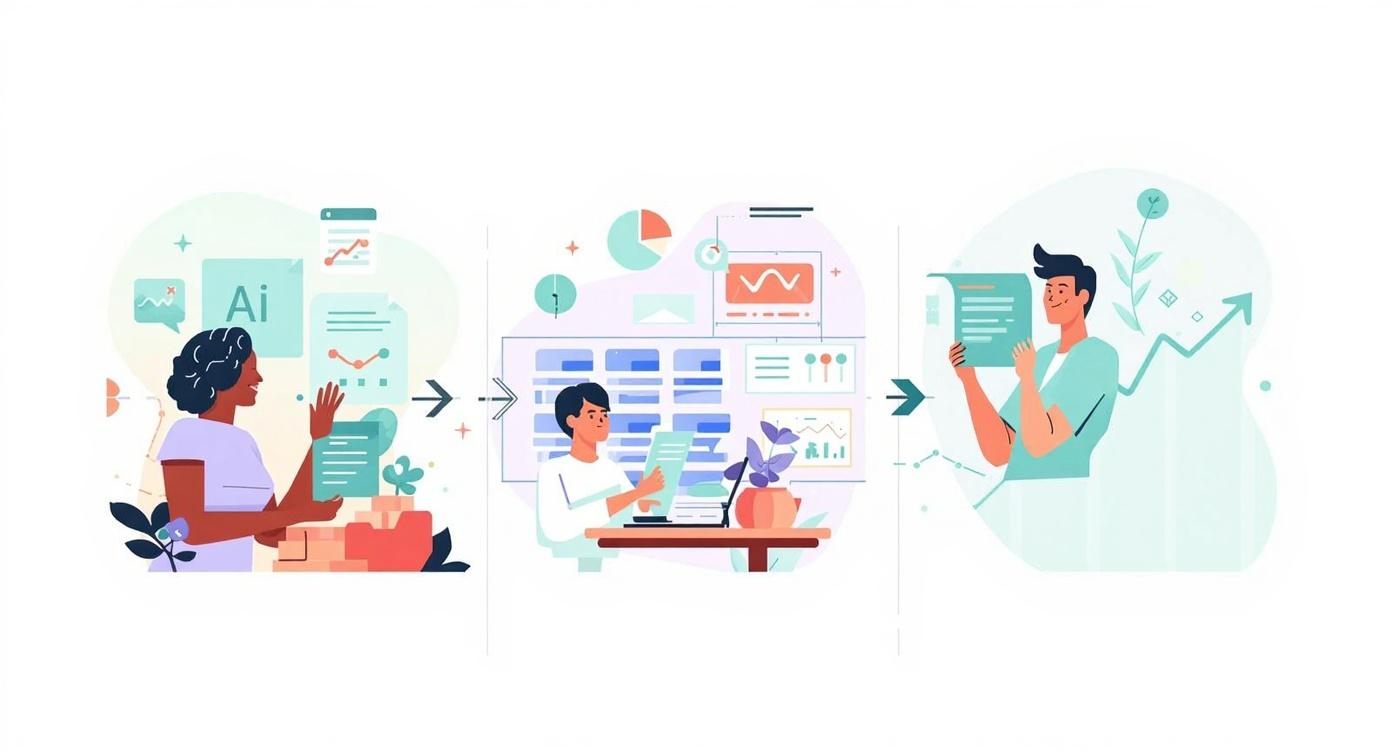
Most writing about knowledge loss in nonprofits focuses on the executive director. That makes sense, because founder and CEO departures are dramatic, board-visible, and expensive. But the majority of the knowledge that actually disappears from a nonprofit every year does not leave through the corner office. It leaves through program coordinators, database administrators, grants managers, and frontline staff who each held a small piece of how the place runs and were never asked to write any of it down.
The sector's turnover rate makes this a volume problem rather than an occasional one. Nonprofit HR's retention research has put annual turnover in social impact organizations around nineteen percent, and smaller organizations and high-emotional-load subsectors run considerably higher. In a thirty-person nonprofit that means five or six departures a year, every year. Each one triggers an exit interview that almost always asks the same set of feelings questions and almost never asks the operational ones.
The reason organizations do not do knowledge capture properly is not that they think it is unimportant. It is that doing it well is genuinely laborious. Somebody has to sit with the departing employee for several hours, take good notes, understand enough about the work to ask the right follow-up questions, then convert a rambling conversation into documentation a successor can actually follow. In an organization where HR is half of the finance director's job, that work simply does not get done. This is exactly the shape of problem where AI moves the needle, because the expensive part is transcription, structuring, and drafting rather than judgment.
What follows covers why the standard exit interview is the wrong instrument, what categories of knowledge actually walk out the door, how to design a knowledge interview that surfaces the things people do not think to mention, precisely where AI does and does not belong in the process, the consent and privacy rules that constrain recording, and how to make the resulting document something a successor reads rather than something that sits in a shared drive. If you are dealing specifically with a founder or executive transition, our guide to building institutional memory as leaders leave covers that narrower case.
You Are Running One Interview and You Need Two
The standard nonprofit exit interview is a retention instrument. It asks why the person is leaving, whether they felt supported, what would have made them stay, and whether they would recommend the organization to a friend. That is a legitimate and valuable exercise, and the answers feed workforce decisions that matter. It is also almost entirely useless for preserving operational knowledge, because none of the questions are about the work.
Trying to bolt knowledge questions onto the sentiment interview fails for a structural reason: the two conversations want opposite conditions. The sentiment interview works best when it is confidential, conducted by someone outside the person's chain of command, and ideally anonymized in reporting. The knowledge interview works best when it is on the record, conducted by someone who understands the work well enough to ask a second and third question, and attributed so that the successor knows whose account they are reading. Combining them produces a conversation that is guarded about feelings and shallow about process.
The fix is unglamorous. Run two separate conversations with two different purposes, two different interviewers where staffing allows, and two different sets of ground rules stated out loud. The sentiment interview stays where it is, typically in the final week, run by HR or a board member for senior roles. The knowledge interview moves much earlier and belongs to the person's manager or the colleague most likely to inherit the work. Splitting them costs you an hour of calendar time and roughly doubles what you get out of both.
This distinction also determines where AI can be involved. Automated analysis of sentiment interviews across many departures is useful and reasonably safe, and we covered that use case in our piece on turning exit interviews and survey data into retention action. Automated handling of knowledge interviews is a different and generally more favorable proposition, because the content is operational rather than personal and the stakes of a misquote are lower.
The sentiment interview
Why they left, and what that says about you
Confidential, conducted outside the reporting line, reported in aggregate. Timed near the last day so the person feels free to be candid. The output is a trend line across departures, not a document about one person.
Value is realized months later, when patterns across six or eight exits point at a supervisor, a workload, or a compensation band.
The knowledge interview
What they know, and who needs it next
On the record, attributed, conducted by someone who understands the work. Timed as early as possible after notice, and ideally started long before notice for high-risk roles.
Value is realized in weeks, when the successor or the interim coverage person opens the document and finds the answer to something nobody else knows.
What Actually Walks Out the Door
Before designing questions it helps to be precise about what you are trying to capture, because organizations routinely spend the interview on the category they least need. The instinct is to ask the person to describe their job. But a job description already exists, the calendar already shows the recurring meetings, and the file share already holds the templates. What is missing is everything that lives only in the person's head because it was never worth the effort of writing down for an audience of one.
Relationship knowledge is usually the largest and least documented category. Which program officer at the family foundation actually reads the reports and which one wants a phone call instead. Which county contact is helpful and which office you should route around. Which board member will say yes to a last-minute site visit. This information is not in the CRM because it is not the kind of thing people type into a CRM, and it takes a successor eighteen months to rebuild from scratch. It is also the category most likely to be shared freely in conversation and most likely to be lost if nobody asks.
Exception knowledge is the second category. Any documented process describes the normal path. The departing employee knows the seventeen situations where the normal path does not apply, what they did instead, and why. The intake form has a fourth page because a funder demanded a specific data element in 2021 and nobody removed it. The reconciliation has a manual adjustment every March because of how the fiscal sponsor closes their year. Undocumented exceptions are what turn a competent successor into someone who looks incompetent for their first six months.
Then there is failure knowledge, which is the most valuable and the least likely to be volunteered. The things the organization already tried that did not work, and the reasons. Without it, new staff propose the same abandoned idea every two years and the institution slowly loses the ability to learn. People do not mention failures unprompted during offboarding because it feels like criticism on the way out. You have to ask directly, and you have to make it clear that the answer is being recorded as organizational learning rather than as a complaint.
Relationship knowledge
Who to call, who to avoid, what each external contact responds to, which internal favors are outstanding, and the history behind partnerships that look simple on paper.
Exception knowledge
The workarounds, the manual steps, the fields that mean something different than their label says, and the annual tasks that only happen once and therefore never got documented.
Failure knowledge
What has already been tried and abandoned, why it did not work, and which constraints made it fail. Prevents the organization from relitigating settled questions every few years.
Timing knowledge
When things are actually due versus when the calendar says, how long each step really takes, and which deadlines have slack behind them and which absolutely do not.
The Two-Week Notice Period Is the Worst Possible Time to Start
Everything above assumes you have a cooperative person and a reasonable amount of time. Frequently you have neither. Two weeks of notice, most of it consumed by closing out active work, wrapping up a grant report, and attending goodbye lunches, is not enough runway to extract six years of context. Worse, motivation is at its lowest. A person who is leaving because they were burned out or poorly managed has very little reason to spend their final days doing unpaid archival labor for the organization.
The organizations that handle this well do not treat knowledge capture as an offboarding step at all. They treat it as an ongoing practice that offboarding merely accelerates. If a program coordinator has been narrating their work into a shared document all along, the exit interview becomes a review and a gap-fill rather than an excavation. This is the single highest-leverage change available, and AI is what makes it feasible, because the historical blocker was that nobody would write those documents voluntarily.
A practical version looks like this. Twice a year, each staff member spends forty-five minutes talking through their current work with a colleague while a transcription tool runs. Nobody writes anything. The recording goes through an AI step that produces a structured draft covering responsibilities, recurring cycles, key contacts, known workarounds, and open risks. The person spends fifteen minutes correcting the draft. The whole exercise costs an hour of staff time per person per half-year and produces a living document that is never more than six months stale. Our piece on systematizing AI knowledge across a nonprofit covers how to store and retrieve those documents once you have them.
If continuous capture is not realistic yet, at least triage. Identify the roles where a sudden departure would create genuine operational risk, which usually means single points of failure such as the only person who runs payroll, the only person with production database access, or the only person who has ever completed a specific compliance filing. Those roles get a knowledge interview on a schedule regardless of whether anyone is leaving. Everyone else gets one at offboarding. That is a fraction of the effort of a universal program and captures most of the risk.
Do not build the program around involuntary departures
A meaningful share of exits are terminations, layoffs, or resignations under strained circumstances. In those cases there may be no knowledge interview at all, and pressing for one can create legal exposure and real unfairness to the person leaving.
This is another argument for continuous capture. The knowledge you already have on file is the knowledge you keep when the departure is not amicable, and no offboarding checklist can substitute for it.
Questions That Surface What People Do Not Think to Mention
The hardest thing about tacit knowledge is that the person holding it does not experience it as knowledge. It feels like common sense. Ask an experienced grants manager what a successor needs to know and you will get the org chart and the deadline calendar, because the genuinely valuable material has been automatic for so long that it no longer registers as information. Good question design works around this by asking about situations rather than about knowledge.
The most reliable technique is to ask for stories with specific edges. Instead of asking what is difficult about the role, ask about the last time something went badly wrong and what the person did. Instead of asking who the key contacts are, ask who they called when they were stuck and what they said. Instead of asking about the process, ask what they would tell a new hire in week one that is not written down anywhere. Concrete prompts retrieve concrete detail. Abstract prompts retrieve the job description.
The second technique is to run the interview against the existing documentation rather than from a blank page. Pull up the actual SOP, the actual form, the actual report template, and walk through it together asking what is wrong with it. People are far better at correcting an artifact than at generating one. This is also where AI helps before the interview even starts, because you can ask a model to read your current procedure documents and generate a list of steps that look underspecified, ambiguous, or likely to have hidden exceptions. That list becomes your question sheet.
The third technique is to insist on the successor being in the room where one exists. A colleague who will inherit the work asks better follow-up questions than any HR staffer, because they know which answers are actually insufficient. Where no successor has been named, send the person who covers the work in the interim. An interview conducted by someone with no stake in the answers produces a transcript nobody ever reads.
Eight questions that consistently produce usable material
Ask these, then ask why after each answer
- Walk me through the last full week. What did you actually do, hour by hour, including the interruptions?
- What happens in this role once a year that will not come up again before my successor is on their own?
- Which of our written procedures do you not actually follow, and what do you do instead?
- Who do you call when you are stuck, inside and outside the organization, and for what kind of problem?
- What have we already tried in this area that did not work, and why do you think it failed?
- What are you worried will break in the first ninety days after you leave?
- What do you have access to that nobody else does, including accounts, files, and physical keys?
- If you could leave one warning taped to this desk, what would it say?
Where AI Does the Work
With the interview designed, the AI contribution becomes easy to describe. In every case the model handles capture, structuring, or drafting, and a person handles the judgment about whether the result is correct. The reason this division produces real savings is that in knowledge capture the labor is overwhelmingly on the capture and structuring side. The judgment takes minutes. The transcription and writing used to take days, which is why it never happened.
Transcription is the obvious first step and the one that changes the interviewer's behavior most. When a manager is not taking notes, they listen properly, follow the thread, and ask the third question that actually gets to the answer. An interview where the interviewer is typing produces a document about what the interviewer could keep up with. An interview where the interviewer is engaged produces a document about what the departing employee knows. The transcription tool is doing something modest and the effect on quality is disproportionate.
Structuring is where the heaviest lifting happens. A ninety-minute transcript is not a usable artifact. Asking a model to convert it into a defined format, with sections for recurring responsibilities, annual cycles, external contacts, known exceptions, systems and access, and open risks, turns an unreadable wall of speech into something a successor can navigate. The prompt matters more than the tool here. Specify the exact sections you want, instruct the model to quote directly where the person gave a specific instruction, and require it to flag anything ambiguous rather than resolving it.
Gap detection is the least obvious use and often the most valuable. Give a model your existing procedure documentation alongside the fresh transcript and ask what the transcript reveals that the documentation does not cover. The output is a list of specific holes in your written process, which is far more actionable than a general sense that the documentation is out of date. Run the same comparison in reverse and ask what the documentation claims that the transcript contradicts, and you will find procedures your organization stopped following years ago.
Cross-departure analysis becomes possible once you have a handful of these documents. Ask a model to read every knowledge interview from the past two years and identify systems, contacts, or processes that appear repeatedly as sources of difficulty. A single person complaining about the reporting database is an opinion. The same complaint in six consecutive knowledge interviews is a capital request. This is also the safest place to use AI on the sentiment side, because aggregate analysis across many exits reduces the risk of any one person being identified, provided your sample is large enough.
Capture
Transcription and summarization
Frees the interviewer to listen and follow up. Produces a verbatim record so the successor can go back to the original phrasing when the summary is not enough.
Structure
Transcript to navigable document
Sorts ninety minutes of conversation into fixed sections. The format should be identical across every interview so that documents from different roles remain comparable.
Gap detection
Transcript versus existing docs
Surfaces what your written procedures never covered and what they claim that is no longer true. Produces a concrete documentation backlog rather than a vague intention.
Drafting
Document to procedure
Turns the captured account into a first-draft standard operating procedure that a successor can correct, which is much easier than asking them to write one from nothing.
Where AI Makes This Worse
The most tempting bad idea is having AI conduct the interview itself. Vendors offer this, the pitch is compelling, and it removes the scheduling problem entirely. It is a poor fit for a nonprofit knowledge interview for a reason that has nothing to do with model capability. The knowledge interview is partly a recognition ritual. Asking someone to spend ninety minutes explaining their expertise to a colleague who wants to learn it communicates that the work mattered. Routing them to a chatbot on their last week communicates the opposite, and departing staff talk to people who still work for you.
There is a narrower version that does work. A structured intake form with AI-generated follow-up prompts, completed asynchronously, is a reasonable fallback for a low-risk role when nobody is available for a live conversation. The distinction is between using automation to cover cases you would otherwise skip entirely and using it to replace conversations you should be having.
Hallucinated procedure is the second risk and the one most likely to cause direct operational harm. When a model converts a rambling explanation into clean documentation, it fills gaps. If the departing employee said the report goes out sometime in the spring and trailed off, the resulting document may confidently state a specific date. A successor following that document will miss the deadline and have no idea why the guidance was wrong. The mitigation is straightforward but must be enforced: require the model to mark uncertainty explicitly, and have the departing employee sign off on the structured document before their last day.
Re-identification in aggregate analysis is the third risk and the one most likely to damage trust. Running AI summarization across sentiment interviews sounds anonymous, but in a twelve-person organization with three departures a year, a summary that mentions a complaint about scheduling in the after-school program identifies exactly one person. Anyone promising anonymity in a small nonprofit should be honest that it is confidentiality rather than anonymity. Set a minimum threshold, commonly at least five responses before anything is reported in aggregate, and hold to it even when leadership wants the analysis sooner.
Finally, there is the failure mode of producing beautiful documents nobody opens. AI makes it cheap to generate a thirty-page knowledge transfer package for every departure, and a thirty-page package is functionally identical to no package. The measure of success is not how much was captured but how often the material is retrieved and used. That is a knowledge management question rather than an offboarding question, and our overview of organizing policies, files, and institutional memory covers the retrieval side in more depth.
The verification step is not optional
An AI-structured knowledge document that the departing employee never reviewed is a confident-sounding document of unknown accuracy, being handed to someone who has no way to tell which parts are wrong. That is a worse position than having no document at all, because it carries authority it has not earned.
Build the sign-off into the offboarding checklist alongside returning the laptop. Fifteen minutes of review from the person who was actually there converts the whole exercise from risky to reliable.
Consent, Recording, and What You Can Honestly Promise
Recording an exit conversation raises questions that a lot of nonprofits handle by not thinking about them. The starting point is state wiretapping law. Federal law and most states permit recording with the consent of one party, but roughly a dozen states, including California, Florida, Illinois, Pennsylvania, and Washington, generally require the consent of all parties to a confidential communication. For a remote interview where the departing employee is in a different state than the interviewer, the safe practice is to assume the stricter rule applies. Announcing the recording and obtaining a verbal yes on the recording itself resolves this in ten seconds.
Consent should be specific rather than blanket. Tell the person what is being recorded, who will have access to the transcript, whether an AI tool will process it, how long it will be retained, and what will happen to the recording once the structured document is complete. Most people say yes readily when the purpose is clearly operational. Resistance almost always signals that the person believes the recording is really about performance or grievance, which is worth surfacing before you start rather than discovering afterward.
Content boundaries matter too. Knowledge interviews in direct service organizations wander naturally into client specifics, because that is how staff remember their work. A case manager explaining a tricky coordination problem will name the family involved. Interviewers need an explicit instruction to redirect, and the structured document needs a rule against client identifiers regardless of what the transcript contains. If your organization handles protected health information or operates under grant confidentiality requirements, the interview recording is subject to those same obligations, and any AI tool touching it needs to be covered by whatever agreements your other systems are.
Retention is the piece most often left undefined. A raw transcript of a departing employee talking candidly about colleagues, funders, and organizational problems is a discoverable document with a long tail of risk. A sensible default is to delete the audio once the structured document is verified, keep the transcript for a defined and short period, and retain the structured document indefinitely as an operational record. Whatever policy you choose, write it down and apply it consistently rather than deciding case by case.
Say these things out loud before you press record
Ten seconds each, and they prevent most of the problems
- This conversation is about the work, not about your performance or your reasons for leaving.
- I am recording, an AI tool will produce a transcript and a summary, and here is who will read it.
- Please avoid naming clients or participants. If you need an example, describe the situation instead.
- You will get the summary to correct before it goes to anyone else, and you can strike anything.
- The audio is deleted once the summary is signed off. The summary stays as an operational record.
Making the Document Something People Actually Open
The graveyard of nonprofit knowledge management is full of thorough transition documents that were never read. The problem is rarely quality. It is that the document was designed as a record of a conversation rather than as an answer to questions a successor will have, and it lives somewhere nobody looks. Fixing this is mostly a matter of format and placement rather than content.
Format first. The document should be organized around the successor's calendar rather than around the interview's chronology. What happens weekly, what happens monthly, what happens once a year and when, what to do when the following six things go wrong. A successor in week three does not want a narrative. They want to find the answer to a specific question in under a minute. Ask the model to produce that structure explicitly, and reject drafts that read like meeting minutes.
Placement second. The document belongs where the work happens, not in a knowledge management folder. Link it from the role's job description, attach it to the recurring calendar events it explains, and reference it in the onboarding checklist for the position. If your organization has adopted a searchable internal knowledge base, index it there as well. The transition from paper files to searchable systems is worth doing on its own merits, and our piece on moving from filing cabinets to AI knowledge bases covers that migration.
There is a useful third step that most organizations skip. Ninety days after the successor starts, have them mark up the document with what was wrong, what was missing, and what turned out not to matter. That feedback improves the next interview more than any amount of theorizing about question design, and it tells you whether the program is producing value or producing paperwork. If successors consistently report that the document did not help, the honest response is to change the questions rather than to keep filing.
None of this works without someone owning it. In practice the owner is whoever runs offboarding, usually an operations or HR lead, and the ownership needs to include the authority to hold a manager to the knowledge interview when they are busy. A process that depends on goodwill during a stressful two-week window will be skipped exactly when it is most needed, which is during the departures that hurt most.
A first version you can run this quarter
No new software beyond a transcription tool and a chat assistant
- List the roles where a sudden departure would create real operational risk. Usually three to six people.
- Write one fixed document template with the sections every knowledge interview will produce.
- Write one fixed prompt that converts a transcript into that template and flags uncertainty explicitly.
- Run a ninety-minute interview with one of those staff members, with consent stated on the recording.
- Have them correct the draft, then give it to a colleague and ask whether they could do the job from it.
- Fix the template and the prompt based on what that colleague could not answer, then repeat.
Conclusion
Knowledge loss at nonprofits is not usually a dramatic event. It is a slow leak, five or six departures a year, each taking a small amount of context that nobody noticed was load-bearing until something broke six months later. The exit interview has always been the obvious place to plug that leak, and it has never worked, because the interview was designed to measure sentiment and because converting a conversation into usable documentation was more work than any understaffed organization could justify.
AI changes the economics of the second problem without touching the first. Transcription, structuring, gap detection against existing procedures, and first-draft writing were the expensive parts, and they are now cheap. What remains expensive is the judgment: designing questions that surface tacit knowledge, having someone in the room who knows enough to ask a follow-up, verifying that the resulting document is true, and putting it where a successor will find it. Those parts stay human, and an organization that automates the first set while skipping the second will produce a great deal of polished, confident, unreliable documentation.
The bigger opportunity is not better offboarding at all. It is shifting knowledge capture from an exit ritual to a twice-yearly habit, which AI makes affordable for the first time. An organization where every staff member has a current, structured account of their own work is resilient to departures in a way that no offboarding checklist can match, and it is far kinder to the people who leave under circumstances that make a cooperative handover impossible.
Start with one role and one conversation. Record it, structure it, verify it, and hand it to a colleague with a simple question: could you do this job from this document? Their answer will tell you more about what to build than any framework, and the cost of finding out is ninety minutes.
Stop Losing What Your Team Knows
We help nonprofits design knowledge capture that fits the staff and the time they actually have, then build the AI workflow that turns conversations into documentation people use.