
Multi-Agent AI Systems: How Coordinated AI Agents Can Transform Nonprofit Operations
The evolution from single-purpose AI tools to coordinated multi-agent systems represents the next frontier in nonprofit operational capacity. While individual AI assistants can handle discrete tasks—answering questions, drafting content, analyzing data—multi-agent systems coordinate teams of specialized AI agents that collaborate autonomously to complete complex workflows from start to finish. By 2026, 40% of enterprise applications embed task-specific AI agents, and early adopters report 30% cost reductions and 35% productivity gains. For nonprofits operating with lean teams and growing demands, multi-agent systems offer a path to unprecedented scale: enabling three-person development teams to manage thousand-donor portfolios, allowing solo program managers to coordinate multi-site services, and empowering small communications departments to produce enterprise-level content operations. This article explores how coordinated AI agents work, where they create the most value for nonprofits, and how to implement them thoughtfully without losing the human connection that defines mission-driven work.
Most nonprofits currently using AI interact with it through single-purpose tools: ChatGPT for content drafting, a CRM with predictive analytics for donor scoring, or specialized platforms for grant writing assistance. Each tool operates independently, requiring humans to move information between systems, interpret outputs, make decisions, and initiate the next steps. This approach delivers value but maintains humans as the central coordinators of every process.
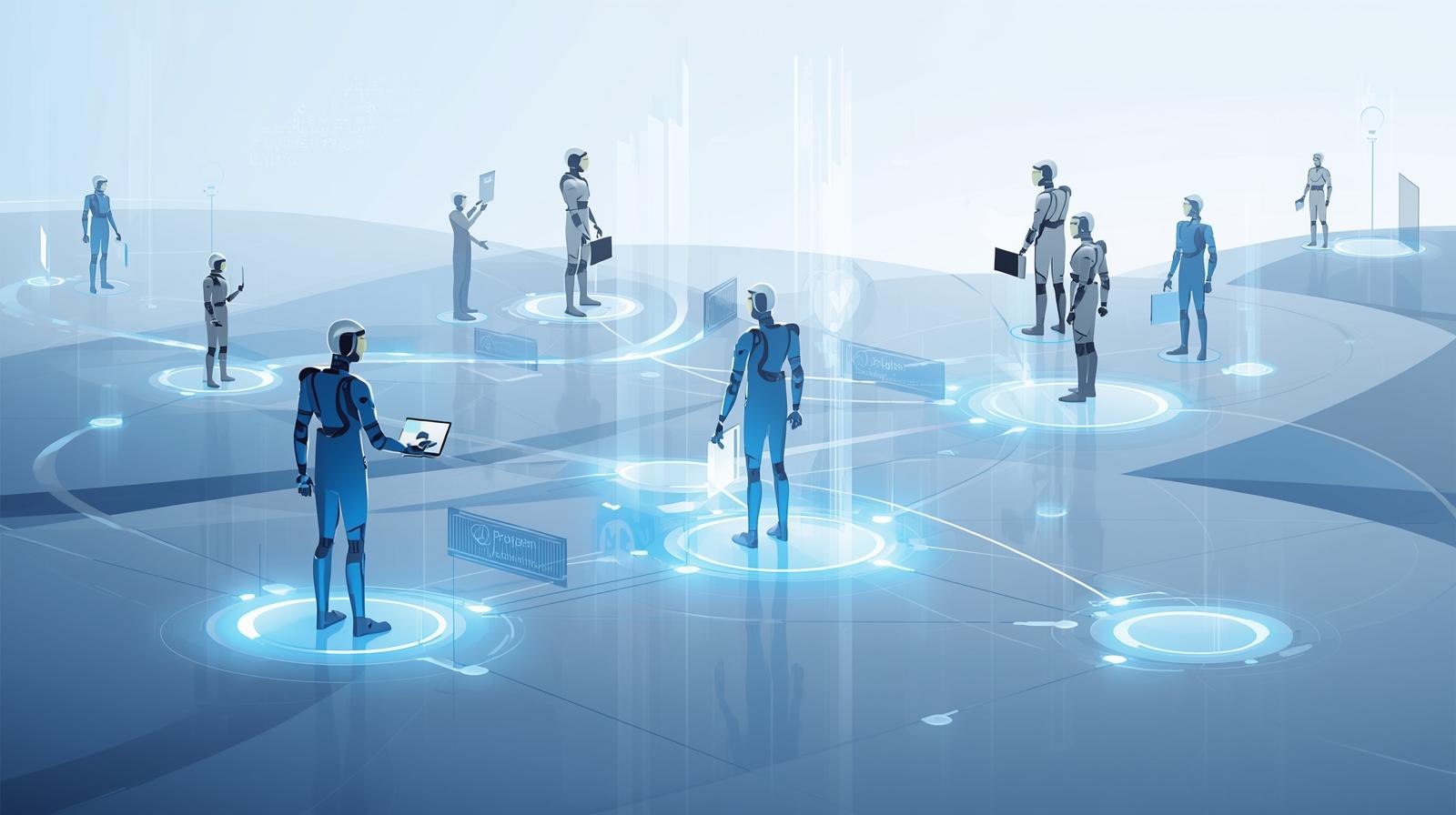
Multi-agent systems fundamentally change this dynamic. Instead of isolated tools awaiting human direction, coordinated AI agents work together autonomously to complete entire workflows. One agent might identify donors showing declining engagement, another analyzes their giving history and preferences, a third drafts personalized outreach, a fourth schedules optimal send times, and a fifth monitors responses to refine future approaches. The system operates continuously, handling hundreds or thousands of these workflows simultaneously, escalating to humans only when judgment calls or relationship decisions require human expertise.
This shift from single agents to coordinated teams mirrors organizational evolution. Just as a nonprofit grows from a founder handling everything to specialized teams coordinating through systems and communication, AI is evolving from isolated assistants to collaborative agent ecosystems. The implications for nonprofit capacity are profound: small teams can manage operations that previously required much larger staff, routine processes run 24/7 without supervision, and humans focus on strategy, relationships, and mission-critical judgment rather than administrative coordination.
Yet multi-agent systems also raise important questions about control, transparency, and the role of technology in mission-driven work. When AI agents operate autonomously across complex workflows, how do you ensure alignment with organizational values? When systems make thousands of micro-decisions daily, how do you maintain oversight without negating efficiency gains? When technology enables unprecedented scale, how do you preserve the authentic relationships and personalized attention that distinguish effective nonprofits?
These questions don't have simple answers, but they demand serious consideration as multi-agent systems transition from experimental to mainstream. This article provides a framework for understanding how coordinated AI agents work, where they create meaningful value for nonprofits, how to implement them responsibly, and how to navigate the governance challenges they introduce. The goal isn't to automate everything possible—it's to use technology strategically to extend human capacity so mission-focused professionals can do more of the work only humans can do: building relationships, exercising judgment, and advancing mission impact.
From Single Agents to Coordinated Teams: Understanding the Evolution
To understand multi-agent systems, it helps to trace the evolution of AI capabilities in organizational contexts. The progression moves through distinct phases, each enabling new types of work while introducing new complexities.
Phase 1: AI Assistants represent the current baseline for most nonprofits. These tools respond to human prompts: you ask ChatGPT to draft an email, it provides text. You ask your CRM to identify major donors, it generates a list. Each interaction requires human initiation, and the AI waits passively between requests. This model works well for augmenting human productivity but doesn't fundamentally change operational capacity—one person with AI assistance can do more, but they're still limited by their own time and attention.
Phase 2: Agentic AI introduces autonomy. Instead of waiting for prompts, agentic systems take initiative based on goals and conditions. An agentic donor retention system might proactively identify donors showing signs of disengagement, analyze what interventions work best for similar donors, draft personalized outreach, and execute campaigns without human intervention. The agent operates continuously, making decisions and taking actions aligned with parameters you've defined. This delivers significant efficiency gains: work happens without human coordination, and systems scale naturally as volumes increase.
Phase 3: Multi-Agent Systems coordinate multiple specialized agents working together on complex processes. Rather than a single agent trying to handle everything, you have teams of agents with complementary capabilities. A donor engagement multi-agent system might include specialized agents for data analysis, content creation, channel optimization, timing coordination, and response monitoring. These agents communicate with each other, share context, and coordinate actions to achieve outcomes that no single agent could accomplish effectively. The result is systems that can handle sophisticated workflows end-to-end, adapting dynamically to changing conditions while maintaining alignment with organizational goals.
What Makes Multi-Agent Systems Different
Multi-agent systems differ from single agents in several critical ways:
- Specialization: Each agent focuses on specific capabilities rather than trying to handle everything, enabling deeper expertise in particular domains
- Coordination: Agents communicate and share context, with orchestrator agents managing workflows and ensuring alignment toward shared goals
- Parallelization: Multiple agents work simultaneously on different aspects of processes, dramatically increasing throughput and reducing cycle times
- Resilience: If one agent encounters issues, others continue working, and orchestration systems route around failures automatically
- Adaptability: Agent teams adjust roles and workflows based on changing conditions, learning from outcomes to improve performance over time
Where Multi-Agent Systems Create the Most Value for Nonprofits
Not every nonprofit operation benefits equally from multi-agent systems. The highest-value applications share common characteristics: they involve complex workflows with multiple steps, require coordination across different types of expertise, operate at significant scale, and currently consume substantial staff time on coordination rather than judgment or relationships.
The following applications represent areas where coordinated AI agents deliver transformative value for nonprofits, based on both enterprise implementations and emerging nonprofit-specific deployments.
Donor Lifecycle Management
Coordinating personalized engagement across the entire donor journey
Traditional donor management requires development staff to manually coordinate acquisition, cultivation, solicitation, stewardship, and retention activities. Multi-agent systems can autonomously manage these workflows at scale while maintaining personalization.
Agent Team Composition:
- Acquisition Agent: Identifies potential donors through prospect research, social media analysis, and behavioral signals
- Segmentation Agent: Analyzes donor profiles to determine optimal engagement strategies and giving capacity
- Content Agent: Creates personalized communications based on donor interests, giving history, and engagement preferences
- Channel Agent: Determines optimal delivery methods (email, direct mail, phone, social media) for each donor
- Timing Agent: Schedules communications based on donor behavior patterns and response likelihood
- Retention Agent: Monitors engagement signals and triggers intervention workflows when donors show signs of disengagement
- Escalation Agent: Identifies high-priority situations requiring personal outreach from development staff
Impact:
Good360, the sixth-largest US charity, deployed multi-agent systems to improve how they match donated goods with nonprofit partners. Their disaster recovery team uses coordinated agents to rapidly assess needs, identify appropriate resources, and coordinate distribution during emergencies—work that previously required extensive manual coordination. College Possible reduced research time for matching students with institutions from 35 minutes to under three minutes using agent teams that analyze needs, surface options, and synthesize information collaboratively.
Grant Management and Compliance
Automating complex grant tracking, reporting, and compliance workflows
Grants involve intricate workflows: tracking multiple requirements across diverse funders, monitoring spending against budgets, collecting program data, assembling reports, and ensuring compliance with varied specifications. Multi-agent systems excel at this type of structured, multi-step coordination.
Agent Team Composition:
- Requirements Agent: Extracts and tracks deliverables, deadlines, and compliance requirements from grant agreements
- Data Collection Agent: Gathers program metrics, financial data, and narrative updates from various internal systems
- Budget Monitoring Agent: Tracks spending against grant budgets, flags variances, and projects cash flow needs
- Report Generation Agent: Assembles narratives, data tables, and financial information into funder-specific formats
- Compliance Agent: Verifies that reports meet all requirements before submission and maintains audit documentation
- Renewal Agent: Tracks grant end dates, identifies renewal opportunities, and initiates application processes
Impact:
Organizations managing dozens of grants can reduce grant administration time by 40-50% while improving compliance and accuracy. Program staff spend less time responding to data requests because agents automatically collect information from source systems. Executive directors gain real-time visibility into grant portfolio health without manual dashboard updates.
Multi-Site Program Coordination
Managing operations across multiple locations with consistent quality
Nonprofits operating across multiple sites struggle to maintain consistency, share best practices, allocate resources efficiently, and maintain quality standards. Multi-agent systems can coordinate operations while respecting local autonomy.
Agent Team Composition:
- Performance Monitoring Agents: Track program metrics across all sites in real-time, identifying patterns and anomalies
- Resource Allocation Agent: Optimizes staff scheduling, supply distribution, and budget allocation based on need and capacity
- Knowledge Sharing Agent: Identifies effective practices at specific sites and recommends adoption elsewhere
- Quality Assurance Agent: Monitors program delivery against standards, flagging issues for correction
- Coordination Agent: Manages cross-site initiatives, ensuring alignment while respecting local context
Impact:
Organizations reduce administrative overhead for multi-site management by 30-40% while improving consistency and quality. Site directors spend less time on reporting and coordination, more time on local program delivery and community relationships. Central offices gain real-time visibility without creating reporting burdens that alienate field staff.
Genentech's Multi-Agent Research Workflow
Genentech built agent ecosystems on AWS to automate complex research workflows, demonstrating multi-agent coordination at sophisticated scale. Their system coordinates 10+ specialized agents, each expert in molecular analysis, regulatory compliance, or clinical trial design.
Scientists now focus on breakthrough discoveries while agents handle data processing, literature reviews, and experimental design. The system doesn't just assist—it orchestrates entire research workflows autonomously. When scientists identify a promising compound, the multi-agent system automatically initiates safety analysis, reviews similar research, designs initial trials, and prepares regulatory documentation.
While pharmaceutical research differs from nonprofit operations, the principles transfer: complex processes requiring specialized expertise, high-stakes decisions needing human oversight, and workflows where coordination takes as much time as execution. Nonprofits can apply similar orchestration to donor engagement, program delivery, and operational coordination—letting professionals focus on relationships and mission-critical judgment while agents handle structured coordination.
Implementing Multi-Agent Systems: A Practical Framework
Multi-agent systems represent advanced AI implementation, typically suitable for nonprofits that have already successfully deployed single-agent tools and built internal AI literacy. Attempting multi-agent coordination without this foundation often leads to failed implementations and wasted resources.
The following framework provides a staged approach to implementation, emphasizing learning and risk management at each phase.
Phase 1: Readiness Assessment (1-2 Months)
Before investing in multi-agent systems, honestly assess organizational readiness:
- Single-Agent Experience: Have you successfully used AI assistants or single agentic tools for at least 6 months? Do staff understand AI capabilities and limitations?
- Data Infrastructure: Do you have clean, accessible data in structured formats? Can systems share information without extensive manual integration?
- Process Documentation: Are target workflows clearly defined with documented steps, decision points, and success criteria?
- Technical Capacity: Do you have internal or accessible technical expertise to configure, monitor, and troubleshoot multi-agent systems?
- Organizational Culture: Is leadership supportive of automation? Are staff comfortable with AI taking on expanded roles?
- Risk Tolerance: Can you afford failed experiments? Are you prepared for iterations and refinements before achieving production readiness?
If you answered "no" to multiple items, focus first on building foundational AI capabilities through simpler implementations. Multi-agent systems amplify existing organizational capabilities—they don't create them.
Phase 2: Use Case Selection (1 Month)
Choose initial use cases carefully. Ideal first implementations have these characteristics:
- High-volume, standardized workflows: The process happens frequently with consistent steps (e.g., donor acknowledgments, data entry, report generation)
- Clear success metrics: You can objectively measure whether the system improves outcomes (time saved, accuracy improved, throughput increased)
- Limited risk of harm: Failures cause inconvenience rather than mission damage or relationship destruction
- Staff pain points: Current manual processes frustrate team members who would welcome automation
- Measurable resource drain: The workflow consumes significant time that could be redirected to higher-value work
Avoid starting with highly visible, relationship-critical, or politically sensitive processes. Learn with lower-stakes workflows before tackling mission-critical operations.
Phase 3: Pilot Implementation (3-6 Months)
Build or Buy Decision:
Most nonprofits should start with platforms designed for multi-agent coordination rather than building custom systems:
- Salesforce Agentforce: Multi-agent capabilities embedded in nonprofit CRM ecosystem
- Microsoft Copilot Studio: Agent orchestration integrated with Microsoft 365 and Dynamics
- ServiceNow AI Agents: Workflow automation platform with multi-agent coordination
These platforms provide infrastructure for agent coordination, monitoring, and governance—capabilities that would take years to build internally.
Pilot Structure:
- Start with 2-3 coordinated agents handling a specific workflow end-to-end
- Run parallel processes: agents handle new work while staff continue existing approaches for comparison
- Implement rigorous monitoring: track every agent action, decision, and outcome
- Gather continuous feedback from staff who interface with agent outputs
- Establish clear criteria for success, failure, and go/no-go decisions on scaling
Phase 4: Scaling and Governance (6-12 Months)
After pilot success, expand thoughtfully with proper governance:
- Gradual workflow expansion: Add complexity incrementally rather than automating everything at once
- Human oversight protocols: Define what requires human review, approval, or intervention at scale
- Performance monitoring: Establish dashboards tracking agent decisions, accuracy, and outcomes
- Bias auditing: Regularly analyze whether agents produce disparate outcomes for different populations
- Continuous learning: Update agent training, parameters, and workflows based on performance data
- Staff retraining: Help team members transition from process execution to oversight, exception handling, and strategy
Governance and Ethical Considerations
Multi-agent systems operating autonomously at scale raise governance challenges that single-agent tools don't. When systems make thousands of decisions daily without human review, how do you ensure alignment with organizational values? When agents coordinate complex processes, how do you maintain transparency and accountability?
Effective governance balances autonomy with oversight, enabling efficiency while preserving control over mission-critical decisions.
Decision Authority Frameworks
Establish clear frameworks for what agents can decide autonomously versus what requires human judgment:
Fully Autonomous:
- Routine data processing and standardized communications with clear templates
- Scheduling and coordination tasks that follow established rules
- Monitoring and alerting based on predefined thresholds
Supervised Autonomy:
- Content creation for external audiences (agents draft, humans review before publication)
- Resource allocation decisions that impact multiple programs or stakeholders
- Process exceptions that fall outside normal parameters
Human-Only:
- High-stakes donor relationships and major gift strategy
- Decisions affecting beneficiary services or program eligibility
- Strategic choices about mission, programs, or organizational direction
Transparency and Explainability
Multi-agent systems must be explainable to stakeholders—especially when decisions affect people's lives or organizational relationships:
- Decision logs: Record what each agent did, why it made specific choices, and what data informed decisions
- Audit trails: Enable reconstruction of complete workflows to understand how outcomes were reached
- Plain-language explanations: Agents should be able to explain their reasoning in terms humans understand
- Stakeholder disclosure: Be transparent with donors, beneficiaries, and partners about how AI informs decisions that affect them
Preserving Human Connection
The goal of multi-agent systems isn't to eliminate human interaction but to make human time more valuable by focusing it where relationship and judgment matter most:
- Let agents handle coordination and administration so staff can focus on meaningful donor conversations
- Use automation to free case managers for direct client support rather than paperwork
- Enable executive directors to spend more time on strategy and community relationships, less on operational coordination
- Always provide options for stakeholders to reach humans when they prefer personal interaction
Common Governance Failures to Avoid
- Insufficient oversight: Deploying agents without monitoring systems to catch errors before they cascade
- Excessive automation: Removing human judgment from decisions that require empathy, context, or ethical reasoning
- Black-box operations: Inability to explain why systems made specific decisions or took particular actions
- Neglecting bias monitoring: Failing to check whether agents produce disparate outcomes for different populations
- Poor communication: Not informing stakeholders when their interactions involve AI agents rather than exclusively human decision-making
The Future of Multi-Agent Systems in Nonprofits
The shift toward multi-agent systems is accelerating across sectors. Gartner reported a 1,445% surge in multi-agent system inquiries from Q1 2024 to Q2 2025. By 2026, analysts expect 40% of enterprise applications to embed task-specific AI agents, up from less than 5% in 2025. Infrastructure for agent coordination is maturing rapidly, with new protocols like Anthropic's Model Context Protocol (MCP), Google's Agent-to-Agent (A2A), and IBM's ACP providing standardized frameworks for building and governing multi-agent systems.
For nonprofits, this evolution creates both opportunity and risk. Organizations that thoughtfully adopt multi-agent coordination can achieve operational capacity that seemed impossible for lean teams. A three-person development office can manage donor relationships at scale typically requiring ten-person teams. Solo program managers can coordinate multi-site operations that previously needed dedicated coordinators. Small communications departments can produce content volumes that once required full marketing agencies.
Yet the same technology that enables this scale also introduces new challenges. As nonprofits become more dependent on AI coordination, what happens when systems fail? When agents operate across interconnected workflows, how do you prevent cascade failures where one error propagates through multiple processes? When technology handles increasing operational complexity, how do you maintain organizational knowledge and capability to function if systems become unavailable?
The most successful implementations will be those that view multi-agent systems as capacity amplifiers rather than staff replacements. The goal isn't to automate everything—it's to free humans for work that requires judgment, empathy, creativity, and relationship-building while agents handle coordination, administration, and structured processes. This distinction matters profoundly for mission-driven organizations where relationships and values are central to impact.
Looking ahead, expect continued evolution in three areas: First, agent specialization will deepen as systems develop expertise in narrow domains rather than trying to be generalists. Second, agent coordination will become more sophisticated, with orchestration systems managing increasingly complex workflows across diverse agent teams. Third, human-agent collaboration interfaces will improve, making it easier for staff to work alongside agents rather than simply overseeing them. These developments will make multi-agent systems more accessible to nonprofits while also raising the importance of thoughtful governance and ethical implementation.
Conclusion: Strategic Capacity Through Intelligent Coordination
Multi-agent AI systems represent a fundamental shift in how nonprofits can operate. Rather than isolated tools requiring human coordination, coordinated agent teams autonomously manage complex workflows from end to end. This enables small teams to achieve operational scale that previously required much larger staff, freeing human capacity for relationship-building, strategic thinking, and mission-critical judgment.
The opportunity is significant: Good360 improved donation matching efficiency, College Possible reduced research time by 90%, and enterprise organizations report 30% cost reductions with 35% productivity gains. For resource-constrained nonprofits, these efficiency multipliers can mean the difference between serving dozens versus hundreds of constituents, managing a handful of grants versus comprehensive funding portfolios, or maintaining basic operations versus launching transformative initiatives.
Yet implementing multi-agent systems requires more than technical deployment. It demands clear governance frameworks defining what agents can decide autonomously versus what requires human judgment. It necessitates transparency mechanisms ensuring stakeholders understand how AI informs decisions affecting them. It requires ongoing bias monitoring to prevent systems from perpetuating or amplifying inequities. And it demands organizational discipline to preserve human connection in mission-driven work even as technology handles more operational coordination.
For nonprofits ready to explore this frontier, start small with well-defined workflows, build on existing AI literacy and data infrastructure, implement rigorous monitoring and governance from day one, and always remember that the goal isn't maximum automation—it's strategic capacity amplification that enables mission-focused professionals to do more of the work only humans can do. Multi-agent systems are powerful tools, but they're tools in service of mission, relationships, and values that technology cannot replicate and must not replace.
Ready to Explore Multi-Agent AI for Your Nonprofit?
One Hundred Nights helps nonprofits assess readiness for multi-agent systems, identify high-value use cases, implement pilot projects with proper governance, and scale thoughtfully while maintaining mission alignment. We understand the unique challenges of nonprofit operations and design solutions that amplify capacity without sacrificing the human connection that makes your work transformative.