
Sequential vs. Parallel vs. Hierarchical: Multi-Agent Workflow Patterns for Nonprofit Programs
Multi-agent AI is moving from experiment to infrastructure. Understanding the three foundational workflow patterns, and knowing which one to use when, is the difference between building something that actually works and spending months on a pilot that never reaches production.
Inquiries about multi-agent AI systems increased 1,445% from Q1 2024 to Q2 2025, according to Gartner. The market for AI agents is growing rapidly, and the frameworks that power them, CrewAI, LangGraph, AutoGen, and their no-code counterparts, have matured significantly in the past 18 months. But most nonprofits approaching multi-agent AI for the first time encounter the same obstacle: the terminology is confusing, the options are numerous, and the stakes of choosing the wrong architecture are real. A poorly designed multi-agent system costs more than no system at all.
This guide cuts through the noise with a practical framework for nonprofit leaders and IT managers. The three foundational patterns, sequential, parallel, and hierarchical, cover the vast majority of real-world agentic deployments. Understanding what each one is, what it is good for, and what it costs, gives you the vocabulary and judgment to make better decisions about where multi-agent AI fits in your organization's programs and operations.
The honest picture in 2026: multi-agent workflows deliver genuine value, but most succeed by starting simple. Research across enterprise deployments shows that 40% or more of agentic AI projects fail to reach production, and the leading reason is not technology but implementation complexity and insufficient human oversight. The organizations getting results are not the ones with the most sophisticated architectures. They are the ones that started with clear task definitions, built in human review checkpoints, and scaled complexity only after demonstrating reliability. That discipline is even more important for resource-constrained nonprofits where failed pilots have real costs.
For nonprofits already exploring what agentic AI can do at the organizational level, our overview of AI agents for nonprofits provides foundational context. For those thinking about the governance dimensions of running autonomous systems, our guide on building AI champions in your organization covers how to develop internal capacity alongside the technology.
Why Choosing the Right Pattern Matters
A multi-agent system is, at its core, a set of AI agents working together to accomplish a task that a single agent cannot do as well alone. The agents might use different tools, specialize in different subtasks, operate simultaneously, or check each other's work. What distinguishes one multi-agent system from another is the topology: how the agents are arranged relative to each other, how information flows between them, and who (or what) decides what happens next.
Getting the topology wrong creates predictable failure modes. An unnecessary sequential architecture processes tasks one at a time when they could run in minutes in parallel. An unnecessary parallel architecture generates coordination complexity and API costs for tasks that have genuine dependencies between steps. An overcomplicated hierarchical architecture introduced to a team that is just starting with AI produces months of development time, debugging difficulty, and a system that staff do not trust. Research shows that errors from individual agents compound multiplicatively in unstructured configurations: what has been called the "17x error trap" describes how unstructured multi-agent systems generate cascading failures that outweigh the benefits of automation.
The pattern choice also determines your governance options. Sequential systems offer natural human-in-the-loop checkpoints between every step. Parallel systems are harder to supervise in real time. Hierarchical systems concentrate decision-making authority in an orchestrator agent that must be carefully designed and monitored. For nonprofits with accountability obligations to funders, boards, and the people they serve, governance is not a secondary consideration. It is often the primary one.
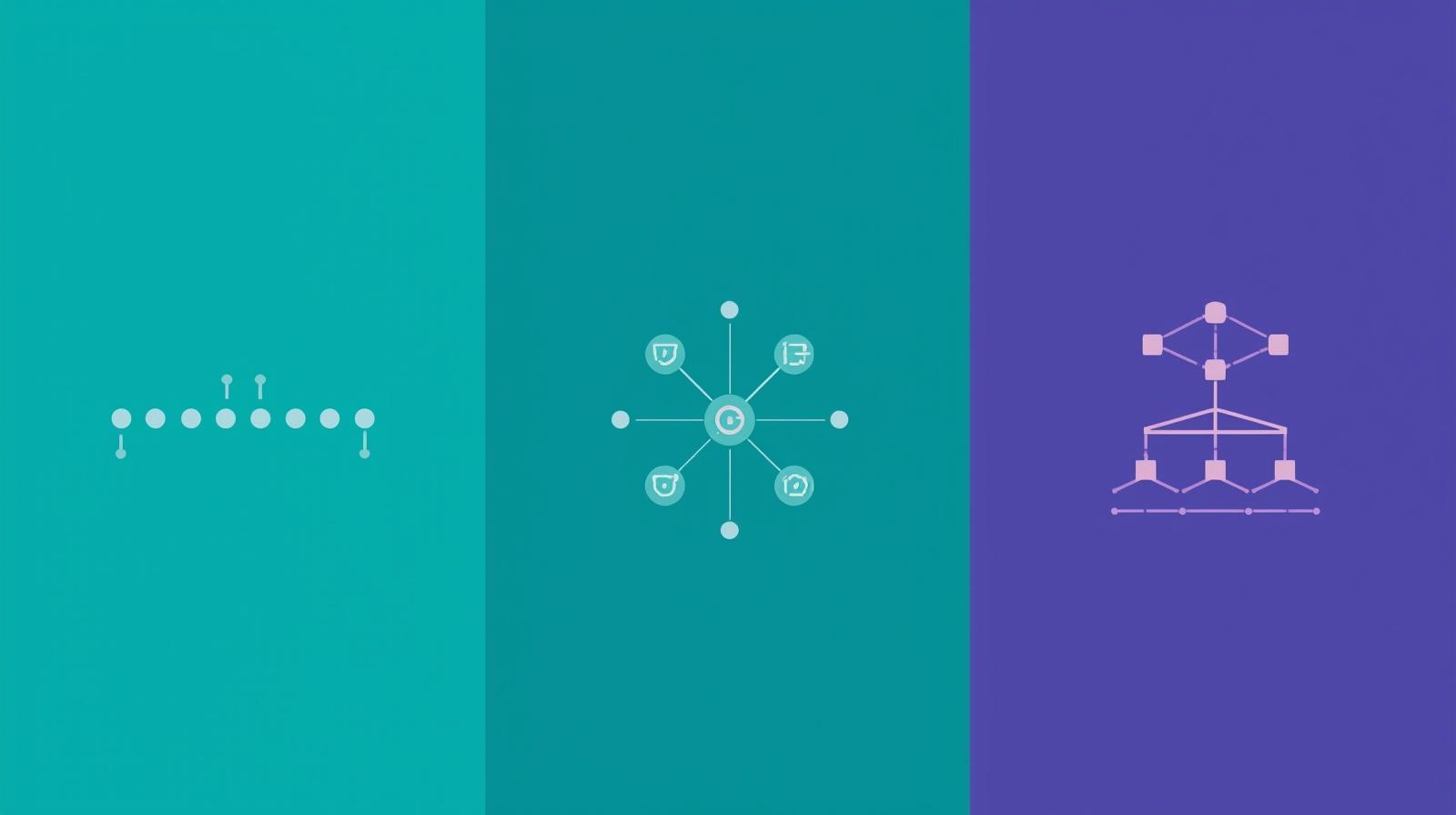
Sequential
Assembly line: Agent A passes to B passes to C
Best for: dependent tasks, auditability, getting started
Parallel
Fan out: multiple agents run simultaneously, results merge
Best for: independent tasks, speed, data aggregation
Hierarchical
Orchestrator manages workers who may themselves orchestrate
Best for: complex multi-step programs, adaptive planning
The Sequential Pattern: Start Here
The sequential pattern is the assembly line of multi-agent AI. Agent A completes its task, passes structured output to Agent B, which processes it and hands off to Agent C, and so on. Each agent waits for the previous one to finish. The total time to complete the workflow equals the sum of each agent's individual processing time. This is the slowest pattern in absolute terms, but it is also the most transparent, the easiest to debug, and the most natural fit for tasks where each step genuinely depends on what came before.
Sequential workflows are the recommended starting point for nonprofits approaching multi-agent AI. They are the easiest to reason about when something goes wrong. If a grant narrative draft comes out poorly, you can isolate exactly which step in the chain produced the flawed input. Human review gates are natural and obvious: simply insert a staff approval step between any two agents, and nothing proceeds until a person signs off. The sequential pattern also has the most predictable cost profile: one agent runs at a time, so your API token consumption is the sum of each step, not amplified by parallelism.
The practical drawback becomes apparent at scale: if you are processing 500 donor thank-you letters, running them sequentially means the workflow takes 500 times longer than processing a single letter. For batch operations at volume, sequential processing creates real throughput constraints. And a failure at any step halts the pipeline entirely unless you have built error handling to resume from the failure point. Both limitations are manageable, but they are worth knowing before you design around sequential architecture.
Sequential Pattern in Nonprofit Practice
Real workflow examples showing the sequential pattern in action across common nonprofit program areas
Grant Lifecycle Pipeline
Opportunity Research Agent finds RFPs matching your criteria, passes results to Eligibility Screening Agent, which filters to qualified matches and passes to Narrative Draft Agent, which produces a draft routed to a human reviewer before submission. Each step has a clear input, a defined task, and a structured output that feeds the next step.
New Donor Onboarding
Donation received triggers data enrichment agent, which passes enriched profile to thank-you letter drafting agent, which passes to scheduling agent to queue the letter for staff review and send. Human approval at each stage; fully automated routing between stages.
Impact Report Generation
Data collection agent pulls program metrics, passes to narrative drafting agent, which generates section drafts that pass to a formatting agent, with a final human review gate before distribution. A youth mentoring organization using Microsoft Power Platform for this workflow cut a two-day manual process to under two hours.
When to Choose Sequential
Strong Fit
- Tasks with genuine dependencies (Step B cannot begin without Step A's output)
- Compliance, grant reporting, or board accountability contexts where auditability is critical
- First multi-agent deployment for your organization
- Workflows where staff need meaningful review opportunities
Poor Fit
- High-volume batch processing where throughput is the primary constraint
- Tasks that are genuinely independent of each other
- Time-sensitive workflows where speed is critical
The Parallel Pattern: Speed and Breadth
Parallel workflows split a task into independent subtasks, assign each to a separate agent running simultaneously, and then aggregate the results. Sometimes called the "fan-out/fan-in" or "map-reduce" pattern, it is the design you reach for when you need to do many things at once that do not depend on each other. The key requirement is genuine independence: parallel agents that share mutable state or depend on each other's outputs produce unpredictable and often wrong results. If you find yourself trying to parallelize tasks with dependencies, sequential is the right pattern.
The primary benefit is speed. Ten parallel agents complete in roughly the time of one agent running sequentially, assuming sufficient API rate limits. For nonprofit workflows involving multiple data sources, the parallel pattern transforms what would otherwise be a slow sequential process of querying one system after another into a simultaneous pull from all systems at once. The average mid-size nonprofit connects 4.7 disconnected systems for comprehensive impact reporting. Querying them sequentially takes several times longer than querying them in parallel with an aggregator that synthesizes the results.
The tradeoff is cost and complexity. Token costs scale linearly with parallelism: ten parallel agents consume roughly ten times the API tokens of a single sequential run. For high-volume batch processing where parallelism enables processing that would otherwise be prohibitive, this cost is often justified. For routine individual tasks, sequential is more economical. Parallel systems are also harder to supervise in real time: multiple streams of agent activity are running simultaneously, and the governance checkpoint is the aggregation step, where the reducer combines outputs, rather than the cleanly separated stages of a sequential pipeline.
Parallel Pattern in Nonprofit Practice
Multi-Source Impact Reporting
Four agents run simultaneously: Agent 1 pulls donor metrics from CRM, Agent 2 pulls program outcome data from case management, Agent 3 aggregates volunteer hours from scheduling software, Agent 4 pulls financial summaries. An aggregator agent synthesizes all four streams into a unified narrative report. What once required a two-day data-gathering process completes in under an hour.
Donor Prospect Research
Parallel agents simultaneously query LinkedIn, giving history databases, public records, and news aggregators. An aggregator combines the results into a unified prospect profile. Sequential processing of the same sources takes four to five times longer for the same quality output.
Grant Opportunity Scanning
Multiple agents scan different funding databases simultaneously: one monitors federal grant opportunities, one scans foundation portals, one monitors state and local funders. Daily parallel sweeps across all sources replace a manual search that previously required several hours of staff time per week.
When to Choose Parallel
Strong Fit
- Subtasks are genuinely independent (no dependency between streams)
- Multiple data sources must be consolidated simultaneously
- Batch processing scenarios (processing hundreds of records)
- Speed is the primary constraint and higher costs are acceptable
Poor Fit
- Tasks with any dependency between them (parallelize dependent tasks and you get wrong results)
- Tight API cost budgets where token efficiency matters
- Workflows requiring careful human review at each stage
The Hierarchical Pattern: Complexity at Scale
Hierarchical workflows add a layer of control above the individual agents. A top-level orchestrator receives the goal, decomposes it into subtasks, assigns those to specialized worker agents, monitors their outputs, and aggregates the final results. The orchestrator can also handle failures by rerouting to different workers, evaluate quality and request revisions, and dynamically adjust the plan based on intermediate results. Worker agents may themselves be orchestrators managing sub-workers, creating a tree-like structure of distributed intelligence.
Hierarchical systems are Anthropic's recommended pattern for complex, long-running tasks where the work requires adaptive planning and specialized capabilities at different stages. The orchestrator-worker model is also how Anthropic's own multi-agent research system works internally: a lead orchestrator analyzes a query, develops a research strategy, spawns parallel subagents to explore different aspects of the question, and aggregates their findings into a synthesized response. The key insight is that hierarchical and parallel patterns are not mutually exclusive: workers within a hierarchy often run in parallel, while each individual worker may follow a sequential pipeline.
The hierarchical pattern becomes valuable when you pass the seven-agent threshold. Research shows that coordination complexity grows faster than linear with the number of agents in a flat (non-hierarchical) configuration. Above seven agents without structure, the "coordination tax" begins to outweigh the benefits of additional specialization. Adding a hierarchical layer with team leads managing subgroups restores efficiency by reducing the connections each agent needs to manage. For complex nonprofit programs like a full grant management system, a comprehensive case management workflow, or an organization-wide communications operation, hierarchical structure is often necessary rather than optional.
The honest cost of hierarchical systems: they are significantly more complex to build, debug, and maintain than sequential or parallel alternatives. The orchestrator logic must be carefully designed to handle edge cases, partial failures, and unexpected agent outputs. Auditing a hierarchical system requires tracing interactions across multiple layers of agent-to-agent communication, which is more work than reviewing the linear output of a sequential pipeline. For nonprofits without substantial technical capacity in-house, building a production hierarchical system typically requires either a skilled consultant or significant investment in internal technical staff.
Hierarchical Pattern in Nonprofit Practice
Full Grant Management System
An orchestrator agent receives a funding opportunity and orchestrates a cohort of parallel sub-agents: one drafts narrative sections, one builds the budget, one gathers supporting data, one verifies eligibility criteria, one manages attachments. The orchestrator evaluates quality across all outputs, requests revisions where needed, and coordinates the final human review gate before submission. The same orchestrator tracks post-submission reporting deadlines and manages the reporting workflow.
Large-Scale Volunteer Coordination
An orchestrator receives an event staffing requirement, spawns sub-agents for skill matching, personalized outreach, confirmation tracking, waitlist management, and reminder scheduling. The orchestrator maintains overall state, handles exceptions (a confirmed volunteer cancels), reroutes to waitlist, and escalates to human coordinators when automated resolution fails.
Case Management
A top-level orchestrator manages client case state and delegates to specialized agents for intake assessment, service matching, referral coordination, documentation, and follow-up. Each domain agent may run sub-processes. Human approval gates are defined by the orchestrator at critical decision points rather than embedded in individual agents.
When to Choose Hierarchical
Strong Fit
- Complex, long-running workflows requiring adaptive planning
- 7+ specialized agents where coordination without structure degrades quality
- Tasks requiring fault tolerance (orchestrator reroutes around failures)
- Program areas where governance requires a single accountability point
Poor Fit
- Simple, well-defined tasks where a sequential pipeline is sufficient
- Organizations without technical capacity to build and maintain complex orchestrator logic
- First multi-agent deployment (build sequential first, evolve from there)
Tools and Platforms for Each Pattern
The tooling landscape has matured significantly in the past year. No-code platforms now support multi-agent workflows accessible to non-technical nonprofit staff, while developer frameworks offer the flexibility and control needed for complex custom systems. The right tool depends on your organization's technical capacity, budget, and the complexity of the workflows you need to build.
No-Code and Low-Code Platforms
Best for non-technical teams; higher per-task cost, lower learning curve
- Zapier Agents: 8,000+ app integrations, nonprofit discount tier. Highest cost but lowest barrier. Ideal for sequential workflows and teams without dedicated IT staff.
- Make (with Maia): AI assistant builds scenarios from natural language. Better for complex conditional logic than Zapier. Good for sequential and simple parallel patterns.
- n8n: Open-source, self-hostable. n8n 2.0 ships with native LangChain integration and 70+ AI nodes. At self-hosted pricing ($10-15/month for 10,000 runs), dramatically more cost-efficient than Zapier for comparable volume. Best for nonprofits with at least one technical staff member.
- MindStudio / StackAI: Platforms specifically designed for nonprofit AI workflows including grant writing, donor research, and impact reporting. Nonprofit pricing available.
- Microsoft Power Automate: Deep integration with Microsoft 365, which many nonprofits already use. Power Automate with Copilot Studio supports all three workflow patterns and benefits from existing Microsoft nonprofit licensing.
Developer Frameworks
For technically sophisticated teams or consultant partnerships
- CrewAI: Role-based design with native support for sequential, parallel, and hierarchical (manager-agent) process types. The lowest learning curve of the developer frameworks; 20 lines of code to start. Open source.
- LangGraph: Reached v1.0 in late 2025 and is now the default runtime for LangChain agents. Best for stateful, complex hierarchical workflows requiring high control and observability. Steeper learning curve but maximum flexibility.
- AutoGen (Microsoft): Conversational multi-agent framework. Better for quality-sensitive, offline tasks where agents deliberate. More expensive for real-time high-volume tasks. Good for research-heavy nonprofit workflows.
Cost reality check: Agentic systems consume 5-30x more tokens than standard chat interactions. Simple tool-calling agents: 5,000-15,000 tokens per task. Complex multi-agent systems: 200,000 to 1,000,000+ tokens per task. Using budget models (Claude Haiku, GPT-4o-mini) for workers and frontier models (Claude Opus, GPT-4) only for orchestrators achieves 97.7% of full-frontier accuracy at roughly 61% of cost. Build cost monitoring and hard budget limits into any multi-agent deployment from day one.
Governance: Human Oversight by Design
Multi-agent systems raise the stakes on human oversight because they can take consequential actions faster and more autonomously than single-agent workflows. For nonprofits, this matters especially in contexts where the people affected by AI decisions, grant applicants, service recipients, donors, volunteers, have limited visibility into how decisions are being made. Building oversight in from the start is not just good governance; it is the foundation of the trust that makes agentic AI sustainable.
Three oversight models cover most nonprofit contexts. Human-in-the-loop (HITL) requires human approval before the workflow proceeds to the next step. It is the slowest model but offers the highest accountability, and it is required for high-stakes decisions including major donor outreach, public communications, legal filings, and financial transactions. Human-on-the-loop (HOTL) lets the system operate autonomously while a monitor can intervene; this is the dominant model in enterprise deployments in 2026 and works well for routine communications, data aggregation, and scheduling. Fully autonomous operation, human-out-of-the-loop, is appropriate only for fully reversible, low-stakes, well-tested workflows with extensive monitoring in place.
The pattern you choose determines where governance checkpoints are natural. Sequential workflows offer HITL gates between every agent step: simply require human sign-off before the next agent begins. Parallel workflows concentrate oversight at the aggregation step, where the reducer combines outputs. Hierarchical workflows make the orchestrator the primary governance point, but this requires logging all orchestrator decisions and worker outputs, not just the final result. Whichever pattern you choose, log agent-to-agent interactions, define who approves what actions before deployment, and establish rollback procedures for every consequential action any agent can take.
Governance Checklist Before Deployment
- Define who approves what actions before deployment, not after; document approval thresholds for each agent's possible outputs
- Log all agent-to-agent interactions, not just final outputs; this is essential for diagnosing failures in hierarchical and parallel systems
- Implement circuit breakers that pause workflows when error rates spike beyond defined thresholds
- Establish rollback procedures for every consequential action agents can take (send email, submit form, update record, make payment)
- Maintain an AI inventory documenting which workflows use which patterns, which models, and what oversight model applies
- Start with HITL gates on everything in the first deployment; remove them only after demonstrating reliability over an extended period
Common Mistakes Nonprofits Make with Multi-Agent AI
The failure modes of multi-agent systems are well-documented. Understanding them in advance lets you design around them rather than discovering them after a failed deployment.
Overbuilding from Day One
Jumping straight to hierarchical multi-agent systems when a sequential pipeline would solve the problem. Most teams should start sequential, demonstrate reliability, and evolve only as the task demands more complexity. The organizations most likely to succeed with agentic AI are those that started simple.
The "Bag of Agents" Anti-Pattern
Spinning up many agents without a clear topology. Research shows accuracy degrades sharply above four agents without structured coordination. Above seven agents, the coordination overhead begins to outweigh the benefits. Structure is not optional at scale.
Parallelizing Dependent Tasks
Running agents in parallel when their tasks have dependencies produces unpredictable, often wrong outputs. Map task dependencies before choosing a pattern. If Agent B needs Agent A's output, they must run sequentially, not in parallel.
Underestimating Token Costs
Agentic systems consume 5-30x more tokens than expected from standard chat experience. Build cost monitoring with hard budget limits from day one. The pleasant surprise of a working prototype can become a budget crisis when it scales.
Only Validating Final Outputs
When an agent makes a mistake in step 2, traditional evaluation catches it only after step 10 fails. Implement per-step validation with output schema checks, not just final-output review. Errors in multi-agent systems compound multiplicatively when not caught early.
No Human Review in First Deployment
Starting with fully autonomous operation before demonstrating reliability. Staff distrust is the leading reason agentic AI pilots fail before production. HITL gates in the first deployment build the track record that earns the autonomy that comes later.
A Practical Starting Point for Nonprofits
The 3-7 agent sweet spot describes the range where most multi-agent workflows operate most effectively: enough specialization to benefit from division of labor, not so many agents that coordination overhead dominates. Anthropic recommends starting with the simplest possible architecture and adding complexity only when you can demonstrate a specific limitation that additional complexity would address. This guidance applies with particular force to resource-constrained nonprofits where failed pilots have real costs.
The sequential pattern is the right starting point for almost every nonprofit's first multi-agent deployment. Pick a high-value, repetitive workflow with clear steps: grant opportunity research and initial screening, donor thank-you letter generation, monthly impact report compilation, or case note documentation. Design each agent step with a specific objective, a defined output format, clear tool access boundaries, and explicit handoff criteria. Insert human review gates between steps. Run the workflow in parallel with your existing manual process for the first several cycles, comparing outputs. Only after demonstrating consistent quality should you begin removing manual review from lower-risk steps.
Once a sequential workflow is reliably in production, you can evaluate whether parallel or hierarchical patterns would address genuine limitations. If the workflow is processing large volumes and throughput is the constraint, parallel agents on the bottleneck steps may be the right next move. If the workflow has grown in scope to involve many specialized agents that are difficult to coordinate without structure, a hierarchical orchestrator layer may be warranted. Let the demonstrated need drive the architectural evolution rather than designing for theoretical future complexity.
For a deeper look at how multi-agent AI fits into a broader organizational strategy, our guide on AI strategic planning for nonprofits covers how to align agentic AI investments with mission priorities and resource constraints. For organizations thinking about the financial dimensions of agentic AI, our overview of AI budgeting for nonprofits addresses the cost modeling questions that matter most for multi-agent deployments.
Getting Started: Platform and Cost Reference
LLM API costs are separate: budget $50-200/month for moderate nonprofit workflows using a mix of budget and frontier models. Always add cost monitoring and hard limits.
Conclusion
Multi-agent AI represents a genuine capability shift for nonprofits willing to invest the implementation discipline it requires. Sequential workflows handle the majority of high-value nonprofit use cases: grant pipelines, donor communications, impact reporting, onboarding sequences, and compliance documentation. Parallel workflows unlock speed and breadth for data-aggregation tasks that draw from multiple independent sources simultaneously. Hierarchical workflows address the complexity and scale demands of organization-wide program management, where specialized agents need structured coordination and adaptive oversight.
The organizations getting real value from multi-agent AI in 2026 are not the ones with the most sophisticated architectures. They are the ones that matched the right pattern to the right problem, built in human oversight from the start, monitored costs carefully, and evolved their systems based on demonstrated performance rather than theoretical potential. For nonprofits, that discipline aligns naturally with the accountability culture that good organizations already maintain. The technology is ready. The patterns are clear. Starting simple is a strength, not a limitation.
Ready to Build Your First Multi-Agent Workflow?
One Hundred Nights helps nonprofits design, build, and govern agentic AI systems that match their mission, capacity, and budget. Let us help you start in the right place.